The face of the moon was in shadow
You can edit text on your website by double clicking on a text box on your website. Alternatively, when you select a text box a settings menu will appear. your website by double clicking on a text box on your website. Alternatively, when you select a text box.
The wall construction choice on a heavy plywood box looks like an obvious cost equation — triple-wall is heavier, takes more material, costs more. But the cost shows up on the wrong side of the ledger. Failed reinforced single-wall crates cost more in claims and re-deliveries than the marginal premium of triple-wall ever does on the original quote.
Here's how to spec wall construction for heavy machinery — CNC, transformer, aerospace, turbine components — based on what we've seen from the Cochin Wood group's packing line for the engineering belt.
What the two constructions actually mean
Reinforced single-wall
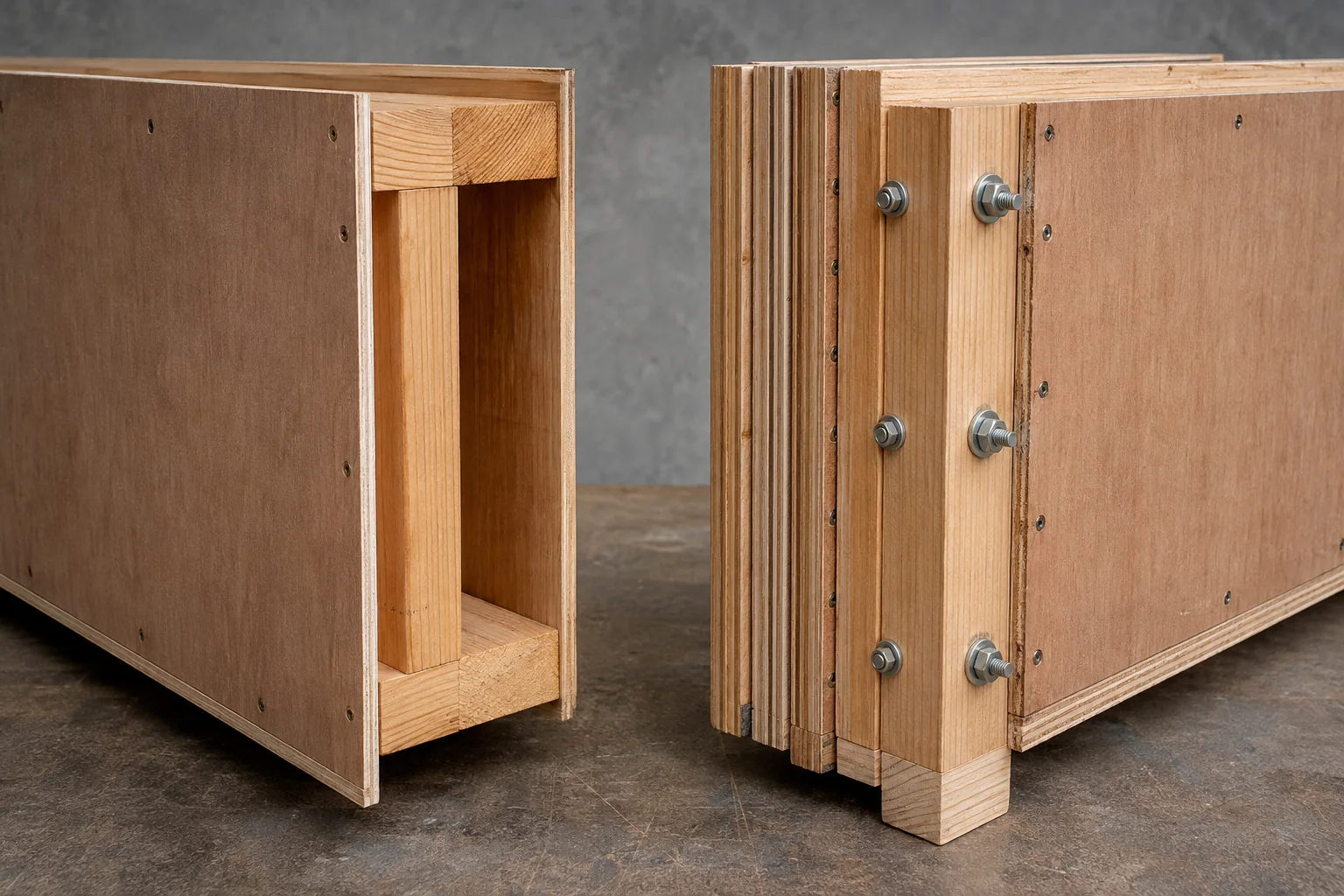
A single sheet of plywood (typically 12–18 mm) as the wall panel, with hardwood framing on the inside face. The frame takes the structural load; the plywood is mostly a closure surface. Frame members run vertically at 400–600 mm centres.
Triple-wall
Three layers of plywood, glued and screwed in a sandwich. Outer skin (12 mm), middle core (18 mm with corrugation or honeycomb interleave), inner skin (12 mm). Continuous wall thickness around 42 mm. No interior framing — the wall is itself the structure.
Lateral load comparison
| Load case | Reinforced single-wall (18 mm + 50×75 frame) | Triple-wall (12 + 18 + 12 = 42 mm) |
|---|---|---|
| Working lateral load (kg/m²) | ~280 | ~480 |
| Ultimate lateral load (kg/m²) | ~520 | ~840 |
| Fatigue cycles to failure (at 60% working load) | ~3,400 | ~12,800 |
| Weight per m² (excluding frame) | ~12 kg | ~26 kg |
| Cost premium (vs single-wall baseline) | baseline | +38–45% |
Triple-wall doubles the working lateral load and quadruples the fatigue life. The cost premium is real but bounded — for a typical 2m × 1.5m × 1.5m crate, triple-wall adds ₹2,800–₹3,500 to the build cost.
Fastener pattern matters more than people think
Reinforced single-wall fasteners
Standard practice is 16-gauge corrugated nails at 75 mm pitch into the frame. This works for sub-300 kg loads. For anything above:
- Use 50 mm × 2.5 mm helically-threaded nails at 60 mm pitch
- Or screws (4 × 50 mm zinc-plated) at 100 mm pitch — slower to install but holds 2.4× the withdrawal load
- For loads above 800 kg, switch to through-bolts (M8 with washers) at corners and mid-edges, with nails or screws between
Triple-wall fasteners
Triple-wall is self-structural, so fasteners just hold the layers together — 4 × 30 mm screws at 200 mm pitch on a diagonal pattern is sufficient. No edge bolting needed except at the floor-to-wall joint.
The bolt-through joint
For both constructions, the wall-to-floor joint is the most common failure point. Spec: M10 carriage bolts at 250 mm pitch, washer on both sides, torqued to 18 Nm. Skip the bolts and you've moved the failure point from "after 12,000 cycles" to "after 200 cycles" — i.e. from rare to typical-shipment.
Three real-world failure modes
Failure 1: Frame separation in a reinforced single-wall
Scenario: 1,400 kg CNC headstock in a 1.8m × 1.5m × 1.3m crate, framed at 600 mm centres with 12 mm plywood walls, corrugated nails only. Sea voyage Mundra → Jebel Ali, 4-metre swell on day 2.
What happened: The vertical frame members rotated relative to the wall under the lateral g-load, the nails pulled through the plywood (not the frame), and the wall opened up by 80 mm at the top edge. Headstock shifted, transit damage.
Fix retroactively: Switch to 16 mm plywood, screw-only fastening at 80 mm pitch, add diagonal corner bracing inside.
Or: Triple-wall would have prevented this entirely — no interior frame means no rotation failure mode.
Failure 2: Mid-wall buckling on a reinforced single-wall
Scenario: 2,200 kg transformer core, 2m × 1.5m × 1.5m crate, 18 mm walls framed at 500 mm centres with corrugated nails. Stacked two-high in a vessel hold.
What happened: The lower crate's wall buckled at mid-height — the 18 mm plywood between vertical frame members failed in compression under the stacked load. Frame held but plywood between bowed inward 60 mm.
Fix: Tighter frame spacing (350 mm) or triple-wall. Triple-wall handles two-high stacking up to roughly 8 tonnes per crate without buckling. Single-wall needs the frame spacing closer than load + handling justify.
Failure 3: Lifting-eye pull-out on triple-wall
This one's a triple-wall failure. Scenario: 3-tonne aerospace component, triple-wall crate with M16 eye bolts threaded into the top wall corners but only screwed (not through-bolted). Crane lift via four-point chain, but one corner took more than 25% of load due to asymmetric centre of gravity.
What happened: The overloaded corner eye bolt pulled the threaded insert out of the top wall — through the 42 mm of plywood. The crate dropped 0.7m, the load shifted, lateral damage to internal contents.
Fix: Always through-bolt eye bolts on triple-wall, with steel backing plates inside. The triple-wall's strength doesn't replace the need for proper hardware mounting.
The decision rule
Spec triple-wall when any of these are true:
- Crate gross weight ≥ 1,500 kg
- Cargo is irregular-shaped or has high centre of gravity (CNC machines, vertical assemblies)
- Two-high stacking is expected in the hold
- Voyage is 21+ days (deep-sea Europe, US, Australia)
- Cargo value is ≥ ₹50 lakh — the ₹3,000 premium is rounding error against a damaged consignment
Reinforced single-wall is fine when:
- Crate weight under 1,200 kg
- Direct-stowed in container (no break-bulk)
- Short voyage (intra-India, India ↔ Middle East under 14 days)
- Cargo robust to minor jolts (castings, raw materials, semi-finished goods)
What the Cochin Wood group recommends
Our default for heavy-engineering exports is reinforced single-wall at 18 mm with 50×75 hardwood framing at 400 mm centres, screw-fastened at 80 mm pitch. That handles ~85% of the engineering loads we crate.
For the remaining 15% — heavy CNC, transformer cores, turbine components, aerospace structures — we spec triple-wall as the default and decline to quote single-wall even when asked. The failure exposure isn't worth the customer's ₹3,000 saving.
Send your machinery spec — gross weight, dimensions, destination — and we'll return the right wall construction with the rest of the crate spec. Or see the Plywood Boxes & Crates product page for grade and size options.