
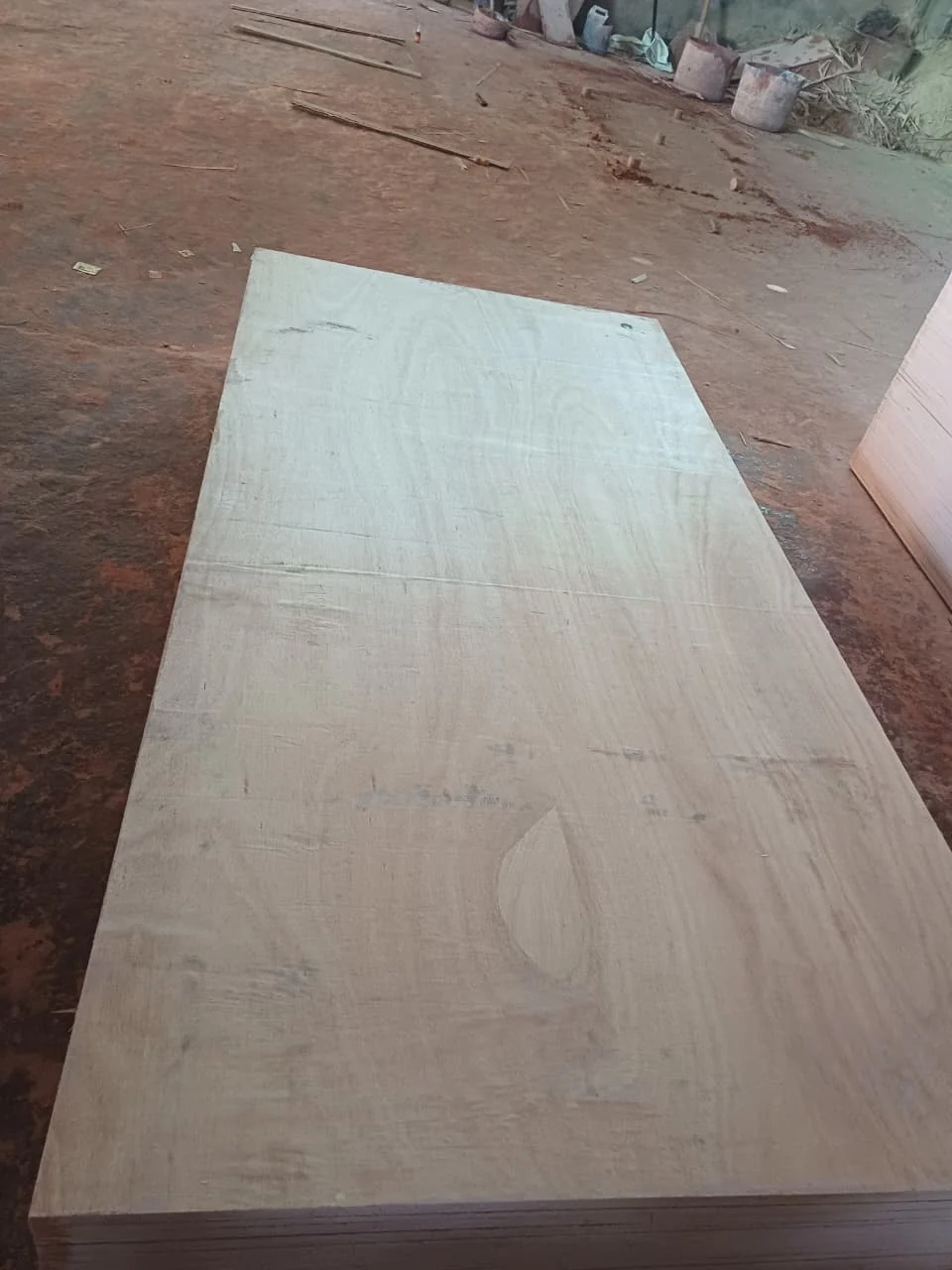
Short answer: plywood warps when one face gains or loses moisture faster than the other — not because the bond fails. Its cross-laminated, balanced build already makes it far more stable than solid timber, so most warp is a handling problem: sheets stored on edge or on a few bearers, used straight off a humid yard, or wetted on one side. Store flat on a fully-supported base, acclimatise to the site before use, seal cut edges, keep the layup balanced, and spec a moisture-rated bond (BWR or BWP) for humid, exterior or marine exposure. A moisture-rated bond resists delamination; it does not stop a panel moving if you wet one side only.
Balanced moisture keeps a panel flat; uneven moisture between the two faces makes it cup.
What "warping" actually is
Warp is any deviation from flat. On a plywood sheet it shows up in three forms, and naming the one you have helps you trace the cause:
- Bow — a curve along the length of the sheet, ends lifting off a flat surface.
- Cup — a curve across the width, edges rising while the centre sits low (or the reverse).
- Twist — the four corners no longer sit in one plane; the sheet winds like a propeller.
All three come from the same root: the two faces of the panel are not in the same moisture state, so one side moves more than the other and the sheet bends toward the drier face.
Why plywood resists warp better than solid wood
Solid timber moves a lot across the grain and very little along it, so a wide board cups and bows readily as it gains or loses moisture. Plywood is built to cancel that out. Each veneer is laid with its grain at right angles to its neighbour — cross-lamination — and a balanced panel carries the same number of plies, in a mirrored layup, on both sides of the centre. The result is a sheet that pulls against itself in two directions and stays far more dimensionally stable than a solid board of the same thickness.
That stability is built in, but it depends on the panel being treated symmetrically. The moment you put one face in a different moisture state from the other — by storage, by exposure, or by finishing one side only — the balance is broken and the sheet moves.
The real cause: uneven moisture
Plywood leaves the press at a controlled moisture content — typically a low percentage by weight. Problems start when that even state is disturbed unevenly. Common triggers we see in the trade:
- Storing sheets on edge or on a few bearers. An unsupported sheet sags under its own weight and takes a set; one exposed face also dries or absorbs faster than the buried one.
- A humid or wet yard. If the bottom sheet wicks moisture from a damp floor while the top face stays dry, the stack cups.
- Using straight off the lorry. Panels brought from a different climate haven't equalised to site humidity yet, so they keep moving after installation.
- Finishing or laminating one face only. A sealed face and a bare face breathe at different rates — a classic recipe for cupping.
- Wetting one side in service. A panel exposed to weather or splash on one face, with the other face dry, will bend toward the dry side regardless of how good the glue is.
Bond grade is about delamination, not flatness
Buyers often reach for a marine or BWP grade hoping it will "stop the warping." It won't, on its own. The bond rating tells you how well the glue line survives moisture and boiling water — it governs delamination resistance, not whether the panel stays flat. A moisture-rated bond keeps the plies from separating in humid or wet exposure; it does not stop a sheet moving if you wet one face and leave the other dry. Flatness is a moisture-balance and handling question; bond grade is a durability question. You need both specified correctly, for different reasons.
To read what a bond grade certificate is actually telling you, see our guide on how to read an IS 710 BWP test certificate, and the difference between the grades in IS 710 vs IS 303 plywood.
How to spec around warp
Specify for the exposure the panel will actually live in, and keep the build symmetrical:
- Match the bond to the exposure. For dry interior use a standard MR-type bond is usually fine; for humid, exterior or marine service spec a moisture-rated bond — BWR or BWP — so the glue line survives the conditions even though it doesn't, by itself, govern flatness.
- Keep the layup balanced. Same veneer species, thickness and orientation on both faces. An unbalanced panel is predisposed to cup before it ever reaches your site.
- Confirm moisture content to spec. Ask for the panel's moisture content on the test certificate rather than assuming a universal figure — confirm it to your requirement.
- Plan to seal cut edges. Cut edges are the fastest moisture path into and out of a panel; sealing them keeps the moisture state even across the sheet.
How to store and handle so panels stay flat
| Do | Avoid |
|---|---|
| Stack flat on a level, fully-supported base — a full pallet or close-spaced bearers | Standing sheets on edge or leaning them against a wall |
| Keep the stack clear of damp floors and direct ground contact | Resting the bottom sheet on a wet or unsealed concrete floor |
| Acclimatise sheets to the site's humidity before cutting or fixing | Using panels straight off the vehicle from a different climate |
| Seal cut edges and finish both faces evenly | Sealing or laminating one face and leaving the other bare |
| Cover the top sheet to shed dust and stray moisture, but let the stack breathe | Wrapping a stack airtight so trapped condensation collects on one face |
The single most common cause of avoidable warp is the first row: sheets stored unsupported. A panel that arrives flat will hold flat if it is stacked flat, kept off damp ground, and given time to settle to the room it will live in.
Where this matters most for our customers
For packing-case and crate makers, flat stock cuts cleaner and nails square, so panels feed through the line without binding. We supply the moisture-rated bonds and balanced layups that exterior and marine work need, with mill test certificates and TDS to confirm the bond and moisture spec. To talk through a specification for your exposure and climate, reach our export desk via contact, or browse the range on products.
FAQ
Does marine or BWP plywood stop warping?
No. A marine or BWP bond resists delamination — the glue line surviving moisture and boiling water — but it does not keep a panel flat on its own. If you wet one face and leave the other dry, even a top-grade bond will bow toward the dry side. Flatness is governed by even moisture and good handling; bond grade is governed by exposure durability. Spec both, for their separate reasons.
Why did my plywood cup after I stored it for a few weeks?
Almost always uneven moisture during storage. Sheets stored on edge, leaned against a wall, or rested on a damp floor let one face gain or lose moisture faster than the other, and the sheet bends toward the drier face. Stacking flat on a fully-supported, dry base usually prevents it.
What moisture content should plywood have?
Panels typically leave the press at a low percentage moisture content by weight, but the exact figure varies by product and bond. Rather than assume a universal number, ask for the moisture content stated on the test certificate and confirm it against your requirement and your site's climate.
Can a warped sheet be flattened again?
Sometimes. A mild bow or cup can relax once both faces return to the same moisture state — lay the sheet flat under even weight and let it equalise to the conditions it will be used in. A twist, or warp that has taken a set, often will not fully recover. Prevention through flat, supported storage is far more reliable than trying to reverse it.
Should I seal the edges of plywood?
Yes, especially for humid or exterior exposure. Cut edges are the quickest path for moisture in and out of a panel, so an unsealed edge lets one part of the sheet change moisture state faster than the rest — which drives cupping and bowing. Sealing edges keeps the moisture even and the panel stable.