
Rubberwood plywood and container weight: the export arithmetic
Export engineering
Panel weight, container dimensions and the loading arrangement all affect the sheet count. Start with a practical planning estimate, then confirm the stuffing plan with your quote.
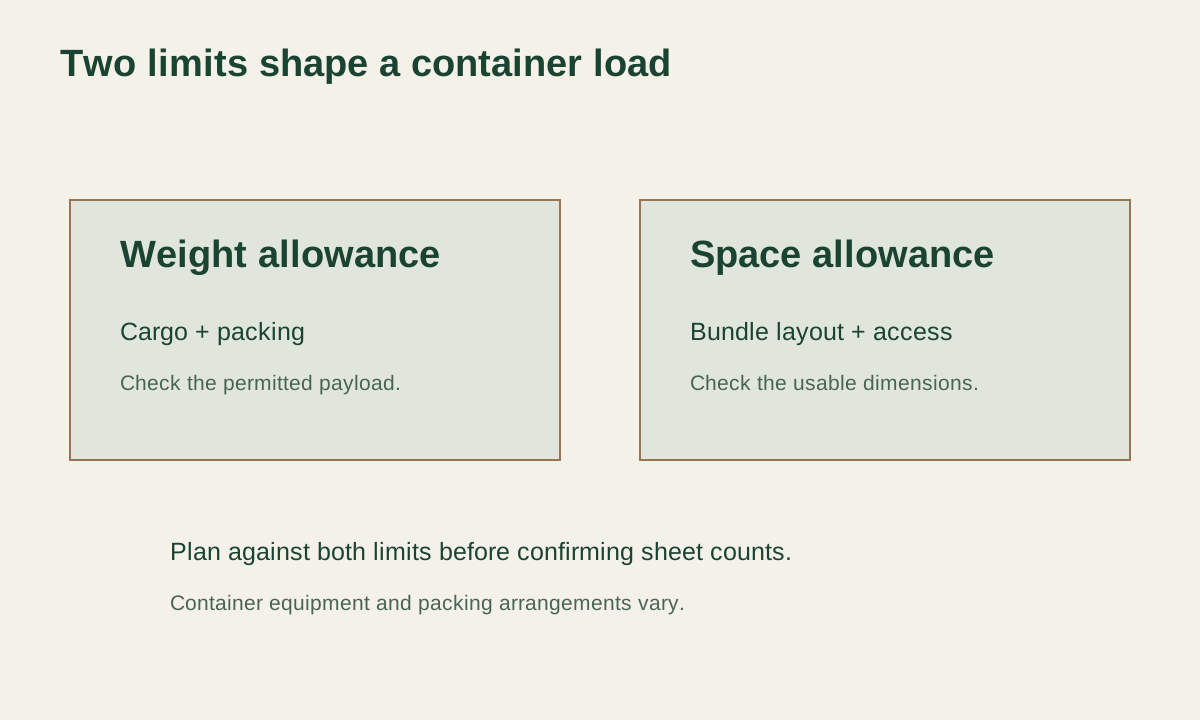
Check weight and the loading arrangement
The agreed load must fit the equipment, clear its door and stay within the lowest confirmed payload for the container, shipping line and inland route. Packing, runners and securing materials use weight and space too. Confirm all of these before booking freight.
The estimator below uses a conservative arrangement: panels laid flat, lengthwise, in straight stacks. It allows two stack positions in a 20 ft standard container and four in a 40 ft standard container. It does not count sheets placed on edge, diagonal loading or mixed arrangements in the unused space. A different agreed plan can give a different result.
| Equipment example | Inside dimensions, L × W × H | Door, W × H | Equipment payload |
|---|---|---|---|
| 20 ft standard | 5900 × 2352 × 2395 mm | 2340 × 2292 mm | 28,130 kg |
| 40 ft standard | 12032 × 2352 × 2395 mm | 2340 × 2292 mm | 28,750 kg |
These are Hapag-Lloyd 20 ft (opens in a new tab) and 40 ft fleet examples (opens in a new tab), checked 12 September 2026. Equipment varies by manufacturer. They are reference dimensions, not a booking or a destination road limit; check the allocated container and route with your forwarder.
Core density and sheet weight
Finished panel weight depends on the core, glue, moisture and actual dimensions. The face veneer alone does not determine it. Our working examples use about 650 kg/m³ for a rubberwood-core panel; replace that assumption with the density or measured weight of your specified panel.
For a 2440 × 1220 × 12 mm sheet: 2.44 × 1.22 × 0.012 = 0.03572 m³. At 650 kg/m³ that is about 23.2 kg per sheet. At 800 kg/m³ it is about 28.6 kg. These are estimates, not measured shipment weights.
| Thickness | Approximate mass at 650 kg/m³ |
|---|---|
| 6 mm | 11.6 kg |
| 9 mm | 17.4 kg |
| 12 mm | 23.2 kg |
| 15 mm | 29.0 kg |
| 16 mm | 31.0 kg |
| 18 mm | 34.8 kg |
| 20 mm | 38.7 kg |
| 25 mm | 48.4 kg |
| 28 mm | 54.2 kg |
Thicknesses here are calculation examples. Confirm the grade, size, thickness and availability in the written quotation.
What a weight ceiling tells you
With an illustrative 26,500 kg cargo payload and 300 kg reserved for packing, 12 mm panels at 650 kg/m³ have a weight ceiling of 1,128 sheets. That is the result of dividing the remaining 26,200 kg by the estimated sheet mass. It is not a claim that 1,128 sheets fit in the container.
In the 40 ft flat-stack example below, a 100 mm height allowance leaves 2192 mm for panels beneath the door opening. Four positions × 182 sheets high gives a layout ceiling of 728 sheets. The estimate is the lower of the weight and layout ceilings. A lighter core saves weight, but it adds sheets only when weight is the binding limit.
Estimate a flat-stack load
Use this to compare assumptions for 2440 × 1220 mm sheets. It is a conservative planning example; our desk confirms the actual packing arrangement, weight distribution, securing and container suitability with your order.
Container load estimator
Adjust the container, panel and packing assumptions. Both weight and stack dimensions limit the result.
- Estimated sheets
- Panel volume
- Cargo including packing
How the estimate is calculated
Sheet volume = 2.44 × 1.22 × thickness in metres. Sheet mass = volume × finished density. Weight ceiling = whole sheets within the entered cargo payload after subtracting the packing mass allowance.
The flat-stack plan reserves 100 mm in total at the ends and sides, and 50 mm between stack positions. Its height is the lower of the inside height and door height, minus your height allowance. Only whole sheets and complete stack positions count. Rotated sheets do not fit flat across these containers.
The result uses the lower of the weight ceiling and layout ceiling. Panel volume excludes packing; cargo mass includes your packing allowance and excludes container tare. The result does not certify floor loading, stack stability, lashing or forklift access. Those belong in the final stuffing plan.
Common questions
How much does a rubberwood plywood sheet weigh?
A 2440 × 1220 × 12 mm sheet at an assumed finished density of 650 kg/m³ weighs about 23.2 kg. Actual panel dimensions, construction and moisture affect the weight. Use a measured sample or the agreed specification for shipment planning.
How many sheets fit in a 20 ft or 40 ft container?
There is no single count for a container size. For the 12 mm flat-stack example with 100 mm height allowance, the layout ceiling is 364 sheets in a 20 ft standard container or 728 in a 40 ft standard container. A lower confirmed payload can reduce those counts. Other agreed loading arrangements give different results.
Does a lighter core always mean more sheets?
No. It can increase the weight ceiling, but sheets must still fit the loading arrangement. When stack dimensions set the limit, reducing density lowers cargo weight without increasing the sheet count.
What should I send for a confirmed loading plan?
Send the product, finished panel size and thickness, grade, quantity, destination and packing preference. We will confirm the specification and loading arrangement with the quote. See our export guide for the order process and packing documentation, or packing plywood for product options.