
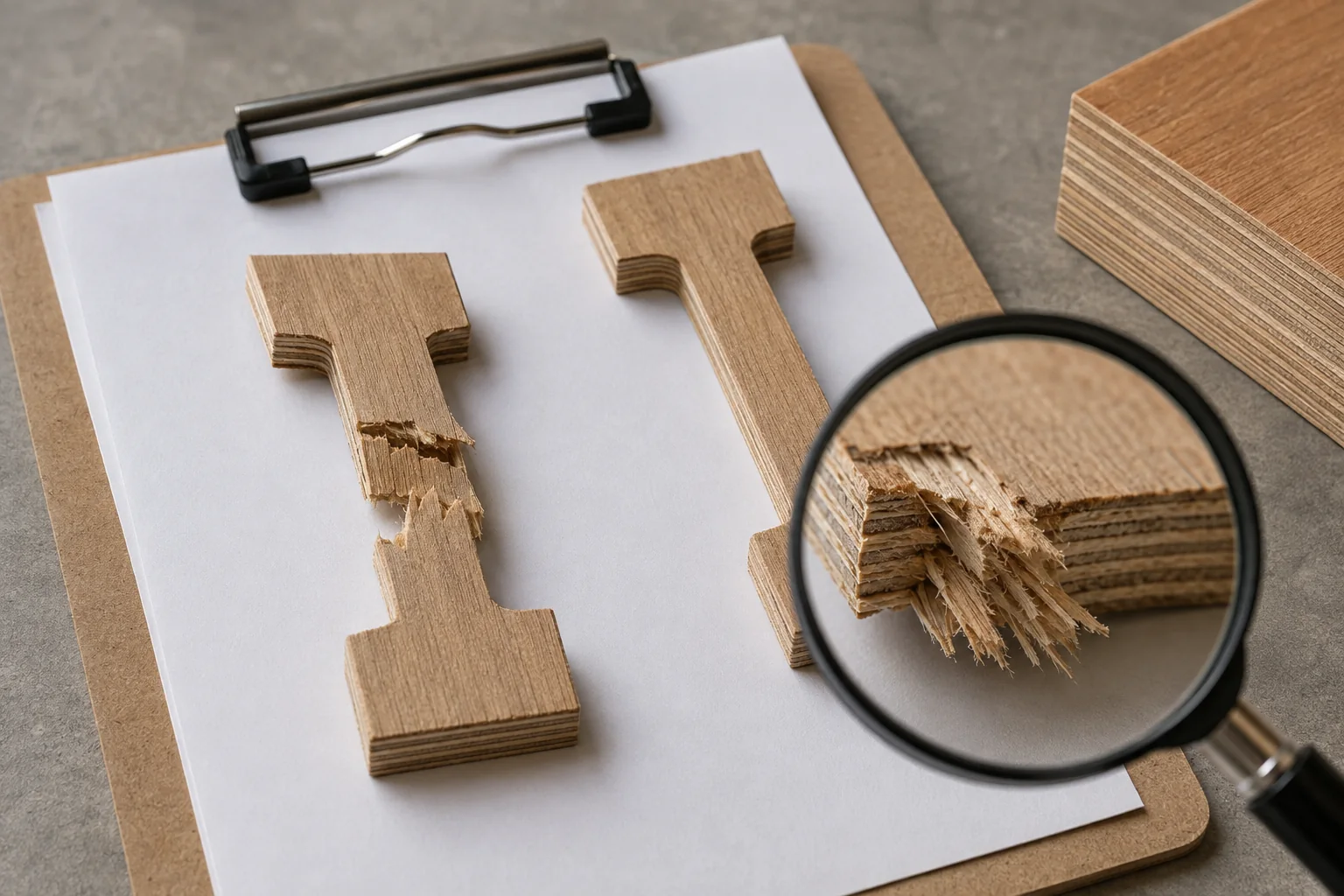
Short answer: an IS 710 BWP marine plywood test certificate proves the panel passed the boiling-water-proof (BWP) bonding, glue adhesion (shear strength) and mycological (fungus resistance) tests defined in IS 710. Read it by checking three things: that the issuing lab is named and the test dates are real, that the glue-shear values are reported as numbers (typically the failing load in newtons, sometimes N/mm² or kgf) for both dry and wet/boiled states, and that the boil test is explicitly logged as passed. A certificate with no lab name, no numeric shear values, or only a "BWP" stamp is not proof of grade.
What IS 710 actually certifies
IS 710 is the Bureau of Indian Standards specification for marine plywood — the BWP (Boiling Water Proof) grade. It is the most demanding bonding class in the Indian plywood standards family, above IS 303 BWR (Boiling Water Resistant) and well above MR (Moisture Resistant). The grade is defined by the glue bond surviving prolonged boiling, not by the face veneer or the look of the panel.
A genuine certificate ties one specific batch of plywood to a set of laboratory tests. It is not a marketing label. If a supplier offers a "marine ply" with no certificate, or a certificate that names no testing laboratory and no test date, you are buying a claim, not a tested product. For the panels themselves, see our marine plywood range; for the lower-cost packing and shuttering grades that are not IS 710, see commercial plywood.
The core tests on the certificate
Every legitimate IS 710 report should show results for these. Treat any missing row as a red flag.
| Test on the certificate | What it measures | What "pass" looks like |
|---|---|---|
| Glue shear strength (dry) | Bond strength of the glue line, tested dry | A numeric value above the IS 710 minimum |
| Glue shear strength (wet / after boiling) | Bond strength after the boil cycle | A second numeric value, plus % wood failure |
| Boiling-water-proof bond (72-hour boil) | Glue-line survival in boiling water | Logged as passed, no delamination |
| Mycological test | Resistance to fungal/microbial attack | Pass after the prescribed exposure period |
| Moisture content | Water held in the panel | Within the IS-specified band |
The single most-faked line is glue shear after boiling. A real certificate prints a numeric value and a percentage wood failure — high wood failure is good, because it means the glue is stronger than the timber around it. If the wet-shear row is blank, or shows only the word "pass", ask for the full numeric report.
Glue line vs face veneer — the trap
A common deception is to sell a panel with a beautiful Gurjan or Okoume face and call it "marine". The face veneer has almost nothing to do with IS 710. The grade lives in the glue and the core. Marine plywood passes IS 710 because of a phenol-formaldehyde (PF) resin bond and a sound core, not because of the species on the surface. A panel can have a premium face and still fail the boil test if the glue is urea-based.
So read the certificate for the bonding resin and the core condition, and treat the face species as a separate, cosmetic line item. This is also why Okoume is a face-veneer option, not a grade.
How to verify the certificate is genuine
Run this five-point check before you trust any IS 710 document:
- Named laboratory. A real report names the testing lab (in-house QC lab, a government institute, or an accredited third party) with an address. "BWP grade — certified" with no lab is not a certificate.
- Numeric values, not just ticks. Dry and wet glue-shear must be actual numbers (typically the failing load in newtons, sometimes expressed in N/mm² or kgf). Pass/fail words alone are insufficient.
- Batch / lot traceability. The certificate should reference a production batch, thickness and panel size — so the paper maps to the goods on your truck.
- Test dates and signature. Real tests have dates and an authorised signatory. Undated or unsigned documents are worthless.
- Density sanity-check. Marine ply is dense. Weigh a sample sheet and back-calculate: density ≈ sheet weight ÷ (panel area in m² × thickness in metres). A genuine IS 710 panel sits in the high hardwood-density range; a suspiciously light sheet usually means gaps, soft fillers, or fewer plies than declared.
A quick weight-math reality check
You can catch many fakes with a weighing scale on the loading dock. For a standard 8 ft × 4 ft sheet, the panel area is about 2.97 m². Multiply that by the thickness in metres and by the expected density, and you get the target weight per sheet. If a "marine" sheet weighs far less than the math says it should, the core is almost certainly hollow or padded — regardless of what the face looks like. Lightweight cores are the most common failure mode behind a glossy face veneer.
What a certificate cannot tell you
A test certificate covers the tested sample, not necessarily every sheet you receive. That is why serious importers pair the paperwork with their own inbound checks: random sheet weighing, edge inspection for core gaps, and — for high-value orders — an independent boil test on a cut sample. Certifications held by the manufacturing mill (such as ISO, FSC or low-emission programmes) belong to that group and partner mills, and should be read alongside, not in place of, the batch IS 710 result. For more buyer questions across grades, see our FAQ, or request a written quote to discuss a tested batch.
FAQ
Is "marine plywood" the same as IS 710 BWP?
Not always. IS 710 BWP is the actual Indian standard for marine-grade bonding. "Marine plywood" is a marketing term that should mean IS 710, but only a batch test certificate proves it. Ask for the certificate, not just the label.
What is the difference between IS 710 BWP and IS 303 BWR?
IS 710 (BWP, boiling water proof) is the marine grade and survives prolonged boiling; IS 303 BWR (boiling water resistant) is a commercial grade that resists moisture but is not rated for the same marine service. They are different standards with different glue-line requirements — never accept a 303 certificate as proof of marine grade.
Why does the certificate report "wood failure" as a percentage?
Because high wood failure is a good sign. It means the glue bond is stronger than the surrounding timber, so when the sample is stressed, the wood fibres tear before the glue line does. Low wood failure with low shear values points to a weak bond.
Can a face veneer like Okoume or Gurjan make a panel "marine grade"?
No. The face veneer is cosmetic. IS 710 grade comes from the phenolic glue bond and a sound core, not the surface species. A premium face on a urea-bonded core will still fail the boiling test.
How can I sanity-check a marine plywood sheet on delivery without a lab?
Weigh a sample sheet and back-calculate density from area and thickness; inspect cut edges for core gaps; and for large orders, boil a cut coupon yourself and watch for delamination. These catch most fakes before payment.