
Every plywood claim a buyer reads — grade, bonding, calibration, film facing — is decided at a specific machine on a specific day. This is the journey a log takes through our group's Perumbavoor operations to become a finished panel, and what each stage means for the board that reaches your site or container.
1. Log selection and conditioning
Plywood begins as a sorting decision. Logs are graded by species, diameter and defect, then conditioned — soaked or steamed — so the wood peels cleanly instead of tearing. Plantation species like rubberwood enter the line here too; how that timber behaves as plywood is its own story, told in rubberwood plywood explained.
2. Peeling
The conditioned log spins against a long knife on the rotary peeler, unwinding into a continuous ribbon of veneer a few millimetres thick — the same way a pencil sharpener makes one long shaving. The ribbon is clipped into sheets, and the quality of this single operation — even thickness, minimal tearing — sets a ceiling on everything that follows.
3. Drying
Fresh veneer is half water by weight. Drying lines bring it down to single-digit moisture content, because resin will not bond wet wood. Under-dried veneer is the quiet cause of many delamination failures blamed on glue.
4. Grading and composing
Dry veneer is sorted: clean tight faces to the outside of the future panel, sound cores to the inside. Defects are punched out and patched, narrow sheets are stitched into full ones. This is where a face becomes "Okoume face" or "paint-grade face" — the face is chosen, not painted on.
5. Glue spreading and lay-up
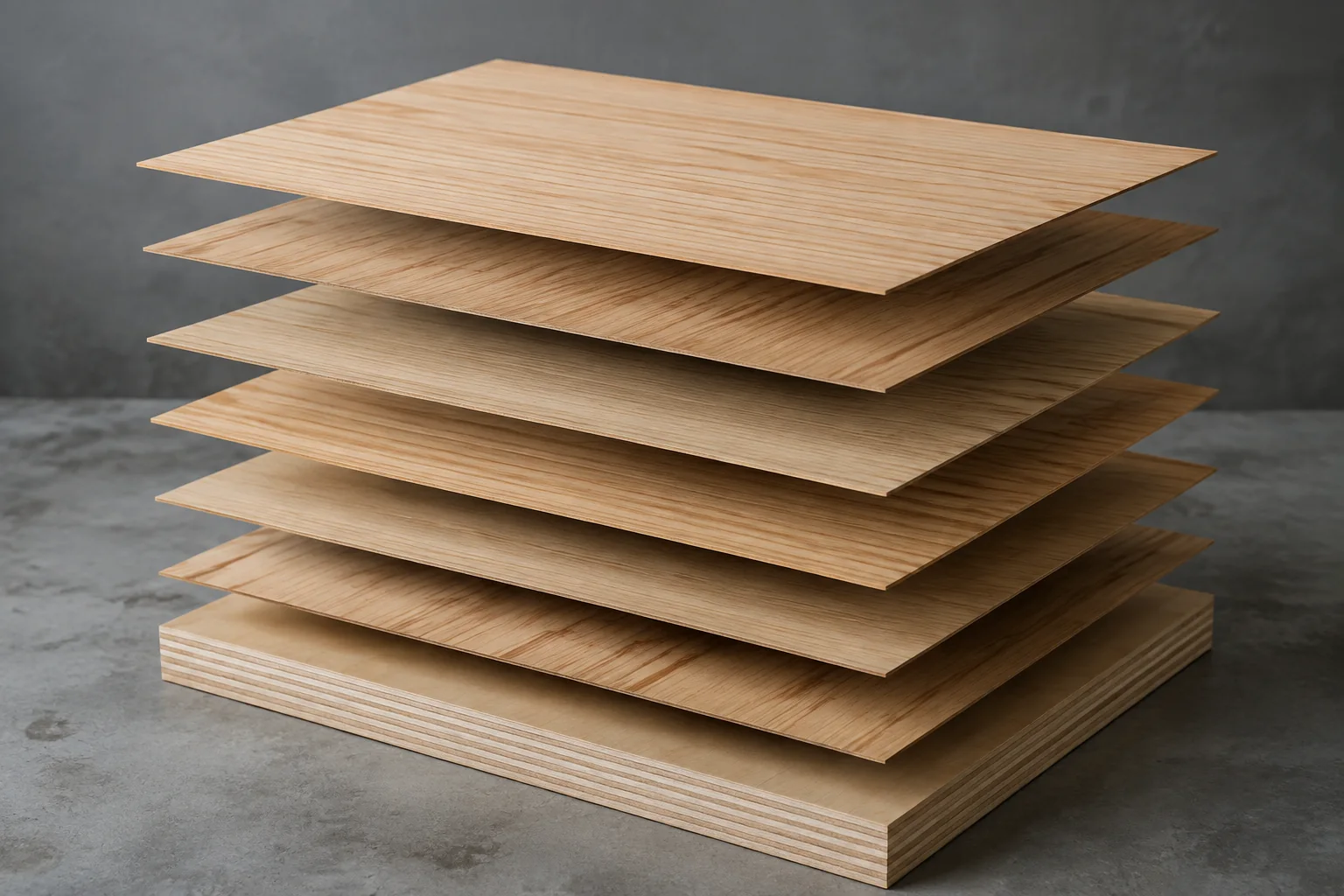
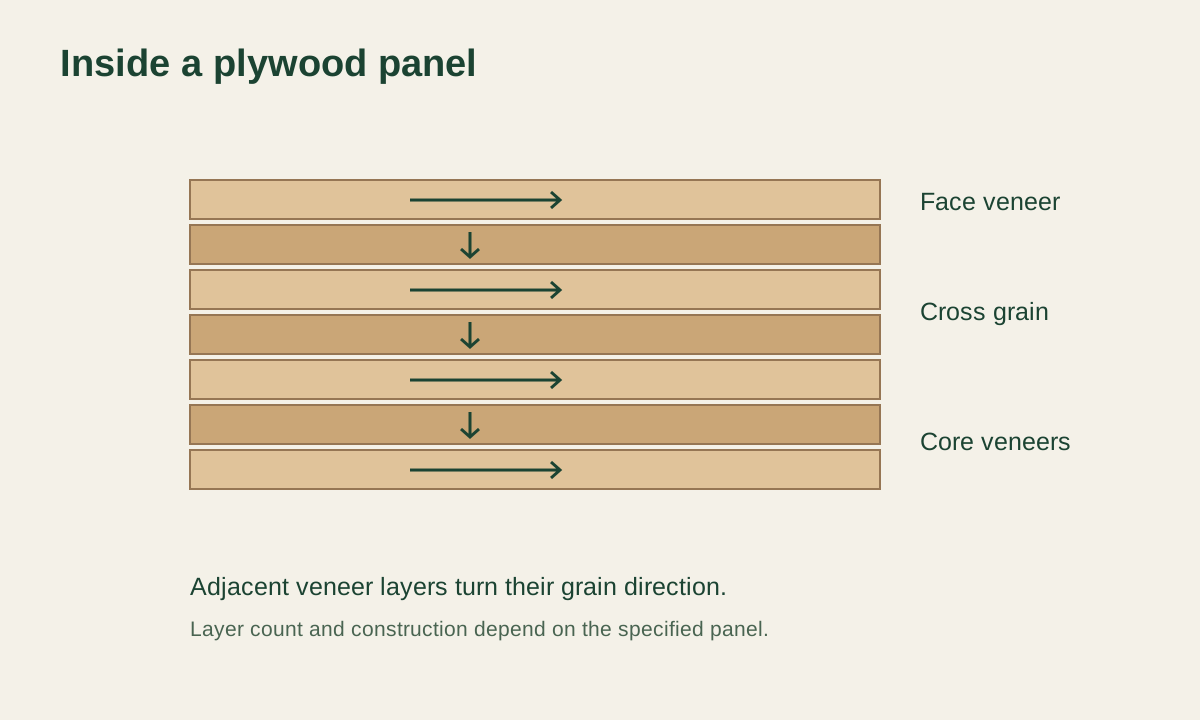
Each core veneer passes through the glue spreader and the panel is assembled cross-grain — every ply at right angles to its neighbours. The cross-banding is what gives plywood its dimensional stability over solid wood. The resin chosen here is the grade: urea-based systems for MR, phenolic systems for BWR and BWP.
6. Pressing
The laid-up panel is pre-pressed cold to consolidate, then hot-pressed — heat and tonnage curing the resin into its final chemistry. Time, temperature and pressure schedules differ by resin and thickness; the press log is, in effect, the panel's birth certificate.
7. Sizing, calibration and facing
Pressed panels are trimmed square, then — for calibrated product — sanded between wide belts to a tight thickness tolerance, which is what CNC shops and edge-bander lines are really buying. Shuttering panels take their phenolic film face in a second pressing; the film is bonded, not stuck on.
8. Testing and certification
Lots are sampled and tested against their standard — moisture, bonding (including boil tests for BWP), density, marking. This is where per-lot test certificates come from, and why a manufacturer can hand you one for the lot you bought rather than a generic brochure.
9. Marking, packing and dispatch
Panels are marked by grade, strapped on bearers or pallets, and loaded — to a truck for domestic supply, or toward the container yard for export, forty kilometres from Cochin Port. From here the story becomes logistics; the paperwork that travels with an export load is set out in export documents for plywood shipments.
FAQ
What is the difference between plywood and block board manufacture?
Plywood is all veneer, cross-banded. Block board swaps the middle for strips of solid timber between veneer faces — lighter and stiffer for some duties; the comparison is in block board vs plywood.
Why does the number of plies matter?
More, thinner plies generally mean a more balanced, stable panel for a given thickness. An edge view tells you more about a board than its label does.
What makes one 18 mm board heavier than another?
Species density, resin loading and pressing. Weight is a clue to construction — which is why unusually light "marine" board deserves suspicion.
Can buyers visit and see the process?
Yes — buyers, specifiers and trade partners are welcome to walk our group's Perumbavoor operations. Write to the export desk with your dates.
What the Cochin Wood group recommends
Buy from people who can show you their process and paper. Forty years of group operations have taught us that the panel is only ever as honest as the line that made it.
Ask the export desk about any stage above, or browse the full product catalogue.