
Plywood price in India: what sets the rate, and how to get a firm quote
Buying guide
There is no single plywood price per sheet, and a published plywood rate list goes stale within weeks. Here is what actually moves the rate, and how to get a firm number.
By Edwin David, Director, Cochin Wood Industries — manufacturer of plywood, packing cases and timber, Perumbavoor, Kerala. · Last updated 23 September 2026.
Why serious buyers quote per spec, not per rate card
Plywood is not a commodity with one market rate. Timber, veneer and resin are bought fresh every month, and their costs move. A rate card printed in January is wrong by March, so any seller still honouring it has either padded the margin to cover the drift or will quietly substitute a lighter panel. Procurement teams that buy plywood in volume know this, which is why they send a specification and ask for a dated, written quote instead of asking for a rate list.
We work the same way. As a plywood manufacturer in India, with our factories in Perumbavoor, Kerala, and in timber since 1986, we price each enquiry against current input costs, and the quote we send is a number we will load against.
The nine variables that set the price of a plywood sheet
Two sheets that look identical on a truck can be priced far apart. These are the variables that decide where yours lands.
| Price driver | What it changes |
|---|---|
| Thickness | More plies means more timber and more resin. An 18 mm sheet carries roughly three times the material of a 6 mm sheet. Typical packing thicknesses run 6, 8, 12, 15 and 18 mm within the standard 6–18 mm range; 19, 20, 22, 25, 30, 35 and 40 mm are available occasionally against order. |
| Grade and bonding | MR bonding under IS 303 costs less than BWR; boiling-waterproof IS 710 marine construction sits at the top of the ladder. |
| Face veneer | A commercial face and an Okoume or Gurjan face are different raw materials at different costs. |
| Core species | What the inner plies are peeled from decides weight, screw-holding and cost. |
| Calibration | Panels sanded to a tight, uniform thickness cost more than packing-tolerance sheets. |
| Sheet size | Price follows area, and odd sizes add cutting wastage that ends up in the rate. |
| Order volume | Truckload and container lots are priced tighter than a handful of sheets. |
| Ex-factory vs delivered | Transport from factory gate to your site is either in the number or on top of it. |
| GST | Indian trade rates are normally quoted ex-factory with GST extra. |
Grade is the biggest step: IS 303 vs IS 710
Moisture-resistant (MR) plywood under IS 303 is the workhorse for packing cases, crates and pallets. It is built and priced for one hard journey, not twenty years of service, and our packing plywood sits here. BWR (boiling water resistant) sheets move up the ladder for humid or repeated-wetting duty. At the top sits marine plywood to IS 710, with boiling-waterproof bonding and denser construction, priced accordingly. Paying marine rates for a one-way export crate wastes money; putting packing ply where IS 710 belongs costs far more when it fails. Match the grade to the duty and the price follows.
Face veneer and core: where identical-looking sheets diverge
Two sheets of the same thickness and grade can still be priced apart because of what they are made from. A commercial face is the baseline. Okoume and Gurjan are premium face veneers, offered as options on MR-packing and BWR constructions rather than as separate grades, so an Okoume-faced sheet is quoted above its commercial-faced twin. Calibration is the final step up. A calibrated E1 panel with an Okoume face on a eucalyptus core, a 16 mm sheet at about 32 kg, is furniture-line material held to tight thickness tolerance and priced well above packing-tolerance ply.
Ex-factory vs delivered, and where GST sits
The quoted rate is only half the invoice. Within India, plywood is normally quoted ex-factory, with GST and transport extra, and we state that basis on every quote we issue. When comparing suppliers, confirm three things in writing: whether the rate is ex-factory or delivered, whether GST is included or extra, and what quantity the transport assumes. A rate that looks lower on the phone often stops looking lower once the basis is on paper. Export buyers are quoted FOB Cochin in USD, with every element of the basis stated the same way.
What to send for a firm quote in one business day
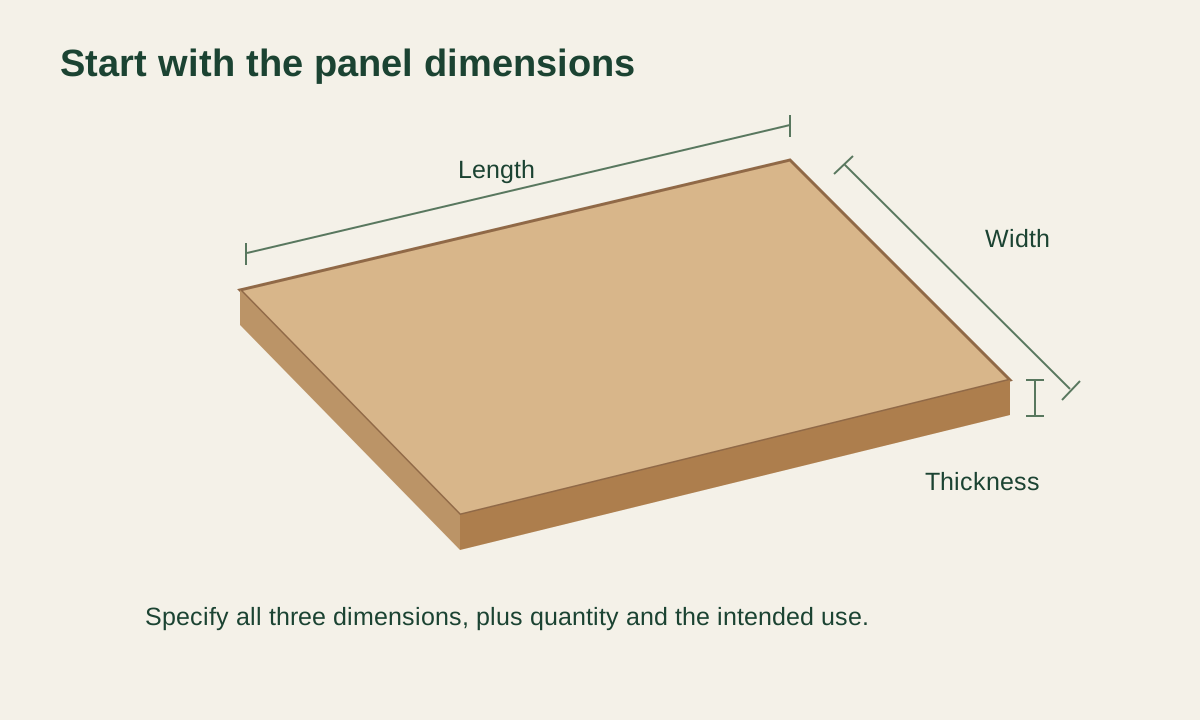
We reply to complete enquiries with a written quote within one business day. Complete means five things:
- Thickness — standard 6–18 mm, or occasional 19, 20, 22, 25, 30, 35 and 40 mm sizes against order.
- Sheet size — the dimensions you need.
- Grade — MR packing, BWR or IS 710 marine. If unsure, name the application and we will grade it for you.
- Quantity — sheets per order, or monthly volume if the requirement is recurring.
- Destination — city and state for transport, or port for export.
Add the face veneer if it matters (commercial, Okoume, Gurjan) and whether the panel must be calibrated. With those in hand we can price to the sheet; without them, any number is a guess. Browse the full range on our products page, or go straight to the quote form.
FAQ
Why is there no plywood rate list on this site?
Because a printed rate list is either out of date or padded. Timber, veneer and resin costs move month to month, and every spec lands at a different number depending on thickness, grade, face, core and volume. We quote per specification, dated and in writing, within one business day.
What is the plywood price per sheet in India?
There is no single figure. A sheet of the same size spans a wide range between 6 mm MR packing grade and 18 mm IS 710 marine, and face veneer, core species, calibration and order volume move it further. Send thickness, size, grade, quantity and destination and we will give you the exact per-sheet number for your spec.
Is GST included in a plywood quote?
For sales within India our rates are ex-factory, with GST and transport extra, and every quote states this basis clearly. Export quotes are in USD on the Incoterms 2020 rule named on the quotation, FCA or FOB Cochin.
How do I get a firm plywood quote quickly?
Email sales@cochinwood.in, call +91 95674 10175, or use the quote form with thickness, sheet size, grade, quantity and destination. Complete enquiries receive a written quote within one business day.
What determines the price of plywood?
The grade (MR, BWR or BWP), the core, the face (Okoume or Gurjan), the thickness, the sheet size, your order volume and the delivery distance. Change any one and the number moves — which is why we quote against your exact specification.
Do larger plywood orders get better rates?
Yes. Full-truckload lots and recurring monthly volumes get our best rates and dispatch priority. Tell us your monthly quantity and we factor it into the quote.
Does thickness change the plywood price?
Yes — a thicker panel uses more veneer and glue, so price rises with thickness. We quote the exact thickness you need: standard 6–18 mm or an occasional 19, 20, 22, 25, 30, 35 or 40 mm size, on minus tolerance stated on the quote.
Can you quote plywood prices in USD for export?
Yes. Export quotes are in USD, on the Incoterms 2020 rule named on the quotation — FCA Cochin for a sealed container handed to your carrier, or FOB Cochin where we deliver on board. Customs duty and any VAT are added at the destination by your clearing agent. Send the spec and destination and a written USD quote follows.
Get a written quote for your spec.
Send your spec — thickness, size, grade, quantity, destination — and we reply with a written quote within one business day, valid as stated in our Terms.
Request a quote