
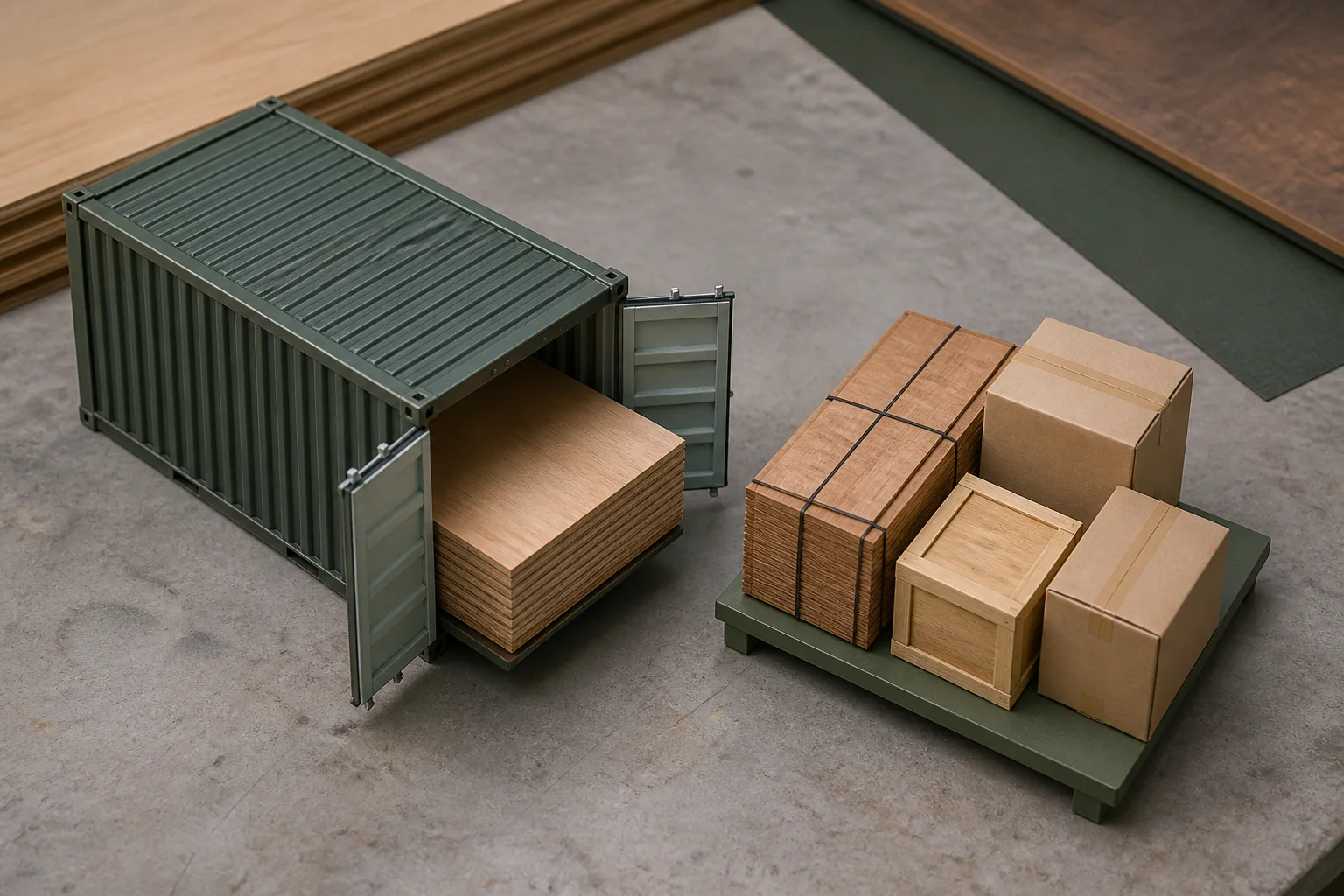
Short answer: for plywood, a full container (FCL) is almost always the better buy once you have enough volume to approach a container's weight or space limit. LCL is billed on the greater of weight or volume (W/M) plus consolidation and handling fees, and because plywood is dense, the weight side of that bill climbs fast. LCL also means extra handling at the consolidation hub, which raises the risk of edge and face damage to your panels. The crossover comes at a fairly small volume for dense cargo, so we size the right mode to your order at quotation.
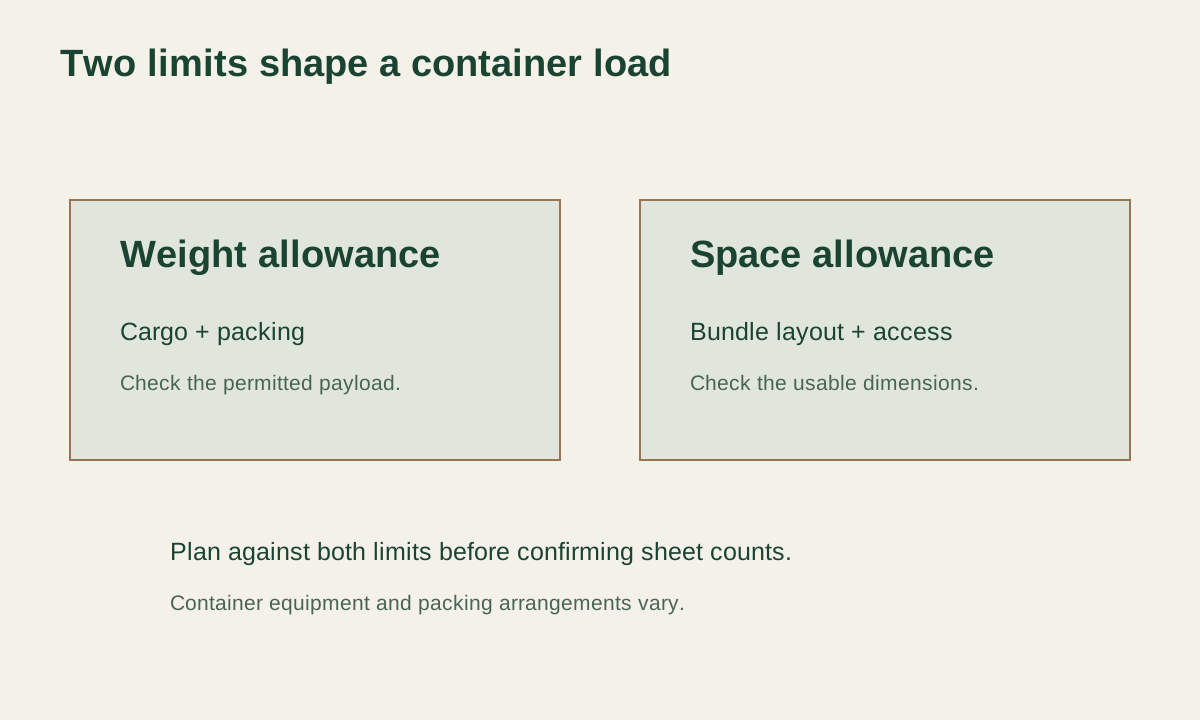
FCL fills your own sealed container; LCL shares one. Dense plywood can reach a container's weight limit or its usable space first.
What FCL and LCL actually mean
FCL is Full Container Load: you book a whole container and it carries only your cargo, sealed from origin to destination. LCL is Less-than-Container-Load: your cargo shares one consolidated container with other shippers' goods, so it is grouped at a consolidation hub on the way out and separated again at the destination hub. The mode you pick changes how you are billed, how your panels are handled, and how much they are exposed to damage.
How LCL is billed — and why density matters
LCL is charged on a "W/M" basis: the carrier bills you on the greater of weight or volume, then adds consolidation and handling fees on top. For light, bulky cargo the volume side usually wins. For plywood it is the opposite — engineered panels are dense, so a modest stack of sheets already weighs a lot, and the weight side of the W/M calculation tends to dominate. As your order grows, that weight-based charge climbs steeply, while a whole container costs roughly the same whether it is half full or loaded to its cap.
This is the same density fact that drives our loose-versus-palletised loading decision: a plywood container can reach its weight limit or its usable space first, and the loading plan checks both. With LCL you are effectively paying for that weight twice over — once in the W/M rate and again in per-shipment handling fees.
The handling and damage angle
An FCL container is packed once at origin and not reopened until it reaches you. An LCL shipment is consolidated and de-consolidated at hubs, which means more manual moves, more re-stacking, and more chances for panel edges and faces to be knocked or scuffed. For finished or veneer-faced panels that matters; cosmetic damage at the edge can write off a sheet. Fewer touches is one of the quieter advantages of shipping a full container.
FCL vs LCL for plywood — side by side
| LCL (shared container) | FCL (full container) | |
|---|---|---|
| How it's billed | Greater of weight or volume (W/M) + consolidation & handling fees | One flat container rate, regardless of fill |
| Effect of plywood's density | Weight side dominates — cost climbs fast as the order grows | Weight only sets the loading plan, not the freight rate |
| Handling | Consolidated and de-consolidated at hubs — more moves | Packed once, sealed door-to-door |
| Damage risk to panels | Higher — extra re-stacking at hubs | Lower — no intermediate handling |
| Best for | Small trial quantities or sample lots | Any order approaching a container's weight or space limit |
Where the break-even sits
The crossover is the point where the LCL charge for your volume approaches the cost of booking a whole container. Past that point you are paying full-container money without the full-container benefits, so you may as well take the whole box. Because plywood is dense, that crossover arrives at a fairly small volume — well before the cube of the container is full. In practice, once you are shipping enough panels to get near a container's payload or space limit, FCL is usually the cleaner and lower-total-cost choice. The exact tipping point moves with the lane, the season, the sheet weight and the LCL rate, so we work it for your specific order rather than off a fixed threshold.
FCL vs the loading-plan decision
Choosing FCL is a separate question from how the container is then packed. Once you are on a full container, the next decision is loose versus palletised loading — a within-FCL tradeoff between sheet-count and handling protection. The two decisions stack: pick the mode first (LCL or FCL), then the loading plan inside it.
How we size it for your order
Tell us the sheet size, thickness, grade, quantity and destination and we work the realistic options — whether your volume is still in trial-sample LCL territory or already past the FCL break-even — and quote it alongside the shipping terms so you see what loads, on what basis, before you commit. For the panel grades themselves start at the catalogue; for made-up packaging see our boxes and crates and pallets pages, and for the terms see FOB Cochin explained.
FAQ
What is the difference between FCL and LCL?
FCL (Full Container Load) means you book a whole container that carries only your cargo, sealed from origin to destination. LCL (Less-than-Container-Load) means your cargo shares a consolidated container with other shippers, so it is grouped and separated at hubs along the way. FCL is billed at one container rate; LCL is billed on the greater of weight or volume plus handling fees.
Why is LCL often expensive for plywood?
LCL is charged on a W/M basis — the greater of weight or volume — plus consolidation and handling fees. Plywood is dense, so even a modest stack of sheets weighs a lot, and the weight side of that calculation tends to dominate and climb fast as the order grows. For dense cargo the weight-based bill rises steeply where a full container would stay at a flat rate.
When should I switch from LCL to FCL for plywood?
When the LCL charge for your volume starts to approach the cost of a whole container, you may as well take the full box. Because plywood is dense, that crossover comes at a fairly small volume — typically well before the container's space is full. Once you are shipping enough panels to get near a container's weight or space limit, FCL is usually the better choice.
Does FCL reduce damage to plywood panels?
Generally, yes. An FCL container is packed once at origin and not reopened until it reaches you, so there is no intermediate handling. LCL cargo is consolidated and de-consolidated at hubs, which means more manual moves and more chances for panel edges and faces to be knocked or scuffed. Fewer touches means lower damage risk, which matters most for finished or veneer-faced sheets.
Is FCL the same as deciding loose versus palletised loading?
No, they are separate decisions. FCL versus LCL is about which shipping mode you use — a whole container or a shared one. Loose versus palletised is a within-FCL question about how the container is packed once you have it, trading sheet-count against handling protection. Pick the mode first, then the loading plan inside it.