
Formaldehyde is the resin chemistry question that follows plywood across borders. The United States regulates panel emissions under CARB Phase 2 and EPA TSCA Title VI; Europe expects CE marking with declared formaldehyde class for construction panels. If you import or specify Indian plywood for these markets, here is what each regime covers and what paperwork a supplier should be able to produce.
Why panel emissions are regulated at all
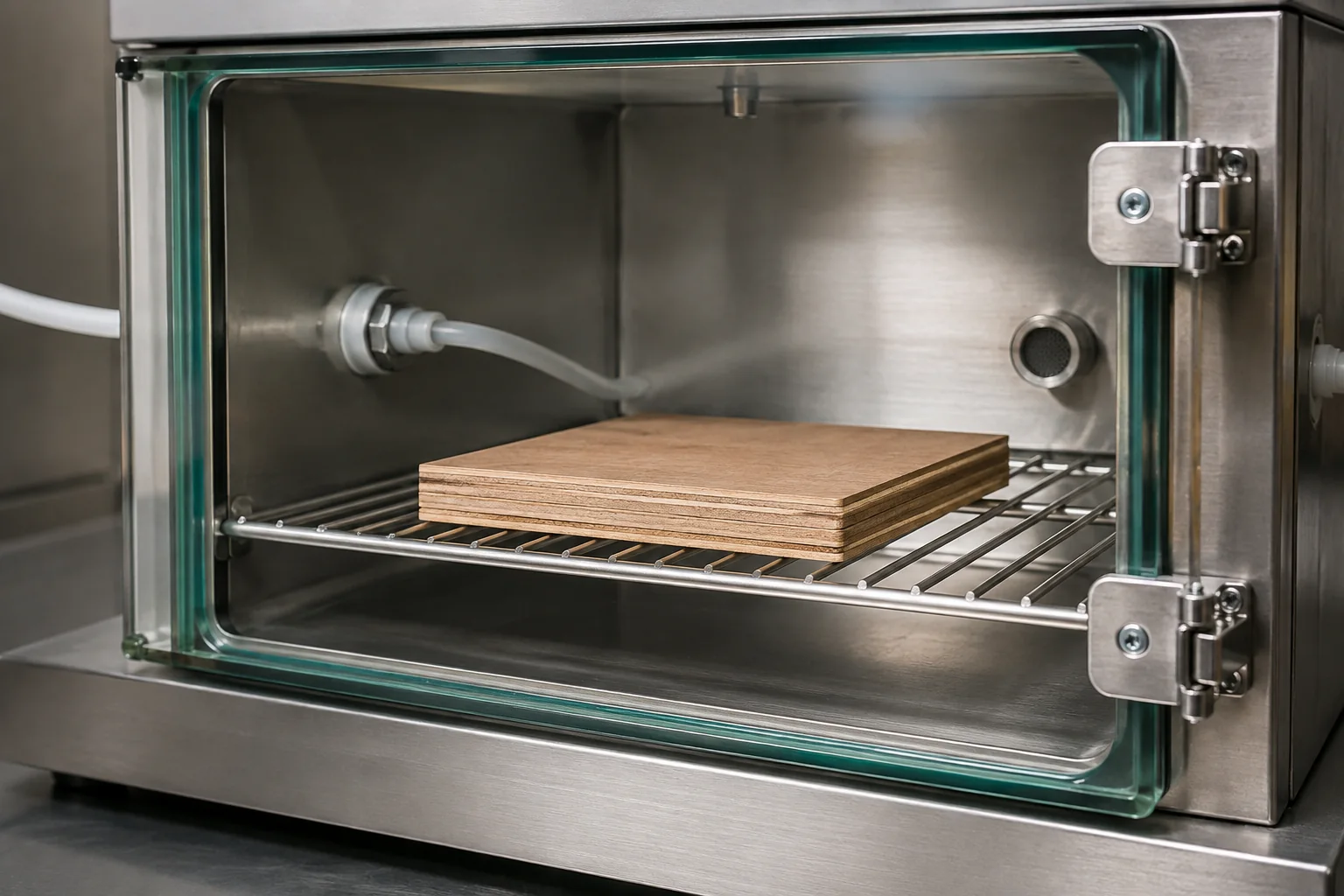
Urea- and phenol-based resins can release small amounts of formaldehyde from finished panels over time, mostly indoors. Regulators answer with emission limits measured in chamber tests — limits on what the panel releases, not on what the recipe contains. That distinction matters when reading certificates: the test is of the board, by lot or production line, under a defined method.
CARB Phase 2 — the Californian benchmark
California's Air Resources Board set emission limits for composite wood products — hardwood plywood, particleboard, MDF — that became the de facto North American reference. "CARB P2 compliant" on a plywood spec means the panel meets those emission ceilings under the prescribed test methods. Because the Californian rule arrived first and set the tone, much of the world's export-grade panel production aligned to it.
EPA TSCA Title VI — the US federal rule
The federal regulation mirrors CARB's limits nationally. For panels going into the US market in scope of the rule, compliance runs through testing and certification under an EPA-recognised third-party certifier (TPC), with labelling and record-keeping duties through the supply chain. The buyer-side translation: ask whether the panels are produced and certified for TSCA Title VI scope, and who the certifier is — a real answer names the body and the paperwork follows.
CE marking and the European route
For construction use in the EU, wood-based panels travel under the harmonised standard for wood-based panels in construction, with a Declaration of Performance and CE marking. Formaldehyde is declared by class — E1 being the standard expectation for interior use, with lower-emission constructions available where projects demand them. CE is the passport for construction application; the formaldehyde class is one line inside it.
Reading supplier claims like a buyer
| Claim on the quote | What to ask for |
|---|---|
| "CARB P2 compliant" | The test report for the product line — method, lab, date |
| "TSCA Title VI" | The third-party certifier's name and certificate scope |
| "CE marked" | The Declaration of Performance with the formaldehyde class stated |
| "E1 / low formaldehyde" | Which standard's E1, and the chamber-test evidence behind it |
The pattern is the same as every other compliance conversation in this trade: a claim is worth the document that travels with it — the same logic as the rest of the export document pack.
Specifying low-emission panels
Where the end use is furniture, interiors or anywhere people live with the panel, specify the emission class on the order line alongside grade and standard — for example, BWR to IS 303, E1 emission class, Okoume face. Low-formaldehyde construction is a manufacturing choice made at the glue kettle; it cannot be retrofitted at the port.
FAQ
Does plywood for the US always need TSCA Title VI certification?
Scope depends on the product type and its end use; hardwood plywood destined for US consumer channels generally needs the compliance chain in place. Confirm scope with your US customs broker, then hand the requirement to the supplier at enquiry stage.
Is E1 the same thing as CARB P2?
They are different regimes with different test methods that land in a similar low-emission neighbourhood. Treat them as separate boxes to tick, not synonyms.
Do phenolic (BWR/BWP) panels emit less formaldehyde?
Phenolic bonds are generally lower-emitting and more stable than basic urea systems — one more reason export-grade panels lean phenolic. The claim still deserves its test report.
Can one panel satisfy the US and EU rules at once?
Yes — export-grade production routinely targets both, with the paperwork issued per destination. State both markets on the enquiry and let the documentation be planned with the lot.
What the Cochin Wood group recommends
Name the destination market on the enquiry and let the emission compliance be built into the lot — panels tested to CARB Phase 2 and EPA TSCA Title VI limits for the US, CE marking for European construction destinations, E1 low-formaldehyde constructions available where the specification calls for them. Original certificates submitted on request.
Tell the export desk your destination market, or browse the catalogue for the panel range.