
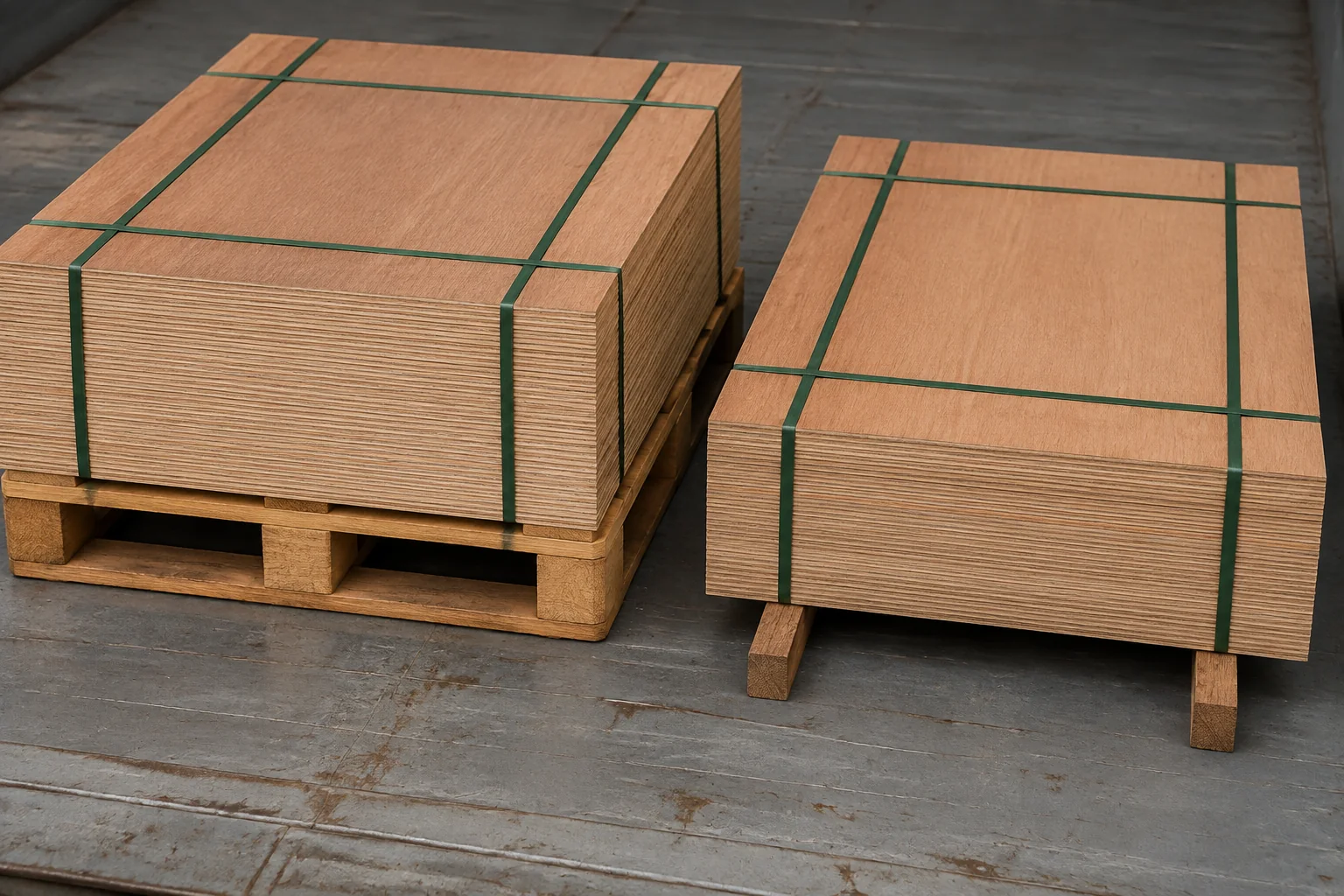
Short answer: a plywood container load is capped by the lower of two ceilings, payload weight and sheet layout — so the real question is how many sheets fit within both and how you trade sheet-count against handling. Loose loading squeezes in the most sheets (lowest freight per sheet) but is slow to load and exposes edges to damage. Palletised loading ships fewer sheets — pallets use weight, floor space and stack height — but loads forklift-fast and protects the panels. We set the loading plan, loose or palletised, to your spec at quotation.
Two ceilings: payload weight and sheet layout
Plywood is dense. At about 26.5 tonnes of cargo — the 40 ft payload in our loading guide, though the exact ceiling depends on the container, the shipping line and the road limits at both ends — plywood at 650 kg/m³ fills only about 41 of a 40 ft box's 67 m³ of gross volume. That does not settle the count: 1220 mm sheets cannot lie two across the box, and door height, stacking and packing can limit the load first. In a 20 ft box, a 28-tonne payload of plywood would need about 43 m³ against its 33 m³.
So you plan to the lower of the two ceilings — and to get the panels in and out without damage.
The weight ceiling starts with sheet weight
The weight ceiling comes from what one sheet weighs, which you can work from density:
density (kg/m³) = sheet weight ÷ (face area × thickness)
A standard 8×4 ft sheet has a face area of 2.9768 m² (2.44 m × 1.22 m). So for a sheet T millimetres thick, density = sheet weight ÷ (2.9768 × T/1000). Turn it around and the lesson is simple: a heavier or thicker sheet weighs more, so fewer sheets fit under the same weight cap. Match the panel to the load you actually need before you optimise the stowage.
Loose vs palletised — side by side
| Loose loading | Palletised loading | |
|---|---|---|
| Sheets per container | Most — no pallet tare or height | Fewer — pallets use weight, floor space and height |
| Load / unload | Slow, manual, labour-heavy | Forklift-fast at both ends |
| Handling damage | Higher — hand-stacked edges | Lower — banded, edge-protected |
| Freight cost per sheet | Lowest | Higher |
| Best for | Bulk commodity loads with good unloading labour | Heavier or finished panels, forklift sites, fragile faces |
A worked example (illustrative — confirmed to your spec)
Suppose a 2440 × 1220 mm sheet weighs about 30 kg (about 15.5 mm thick at 650 kg/m³). Under a 26.5 tonne cap in a 40 ft box, its weight ceiling loaded loose is 26,500 ÷ 30 ≈ 883 sheets; with roughly 750 kg of pallet timber and dunnage it is about 25,750 kg ÷ 30 ≈ 858 sheets.
Neither is the count that loads. In the flat-stack example on our container load estimator — four stack positions and 2,192 mm of stack height — that sheet reaches a layout ceiling of about 564 sheets, so layout sets this load before weight. Pallets also take stack height and floor space, so a palletised plan loses layers as well as payload. What you buy for it is forklift handling and far less edge and face damage. The real figures move with the exact sheet, thickness and container, so we run the loading plan to your spec at quotation — not off a fixed table.
When to choose each
- Choose loose when it is a bulk commodity grade, freight-per-sheet is the priority, and the receiving end has the labour to hand-unload.
- Choose palletised when the panels are heavier, finished or fragile-faced; when the site unloads by forklift; or when you want a faster, cleaner, lower-damage turnaround. Many sea and long-haul shipments lean palletised for the protection alone.
If the panels themselves are part of the question, our plywood pallets and plywood boxes & crates pages cover the made-up options; for the panel grades, start at the catalogue.
How we plan your load
We set the loading plan — loose or palletised, sheets per container, and the pallet build — to your exact sheet size, thickness and container, and we quote it alongside the FOB Cochin terms so you know what loads and on what basis before you commit. Send us the sheet spec, quantity and destination and we will return the loading plan with the quote.
FAQ
Is a plywood container limited by weight or by volume?
Either can govern. Engineered panels are dense, so at about 26.5 tonnes (the 40 ft payload in our loading guide, subject to the line and road limits) a 40 ft box uses only about 41 m³ of its gross volume, but sheet layout, door height and packing can still set the count first. We check both.
How many plywood sheets fit in a 40 ft container?
Two ceilings apply. Dividing the payload cap by the per-sheet weight gives the weight ceiling: a ~30 kg sheet under a 26.5 tonne cap gives roughly 880 sheets loose, and thicker or denser sheets weigh more, so fewer fit. The sheet layout gives the other: a flat-stacked 40 ft box holds about 564 such sheets, so layout sets that count. We confirm the exact count to your spec at quotation.
Does palletising reduce how many sheets I get?
Yes. Pallet timber and dunnage add tare weight, which comes off the payload cap, and the pallets take stack height and floor space. Where weight limits the load the drop is small; where the layout limits it, the count falls by the layers and positions the pallets displace. In return you get forklift-speed loading and unloading and much less handling damage.
Loose or palletised — which is cheaper?
Loose gives the lowest freight per sheet because there is no pallet tare. Palletised costs marginally more per sheet but saves loading and unloading labour and reduces damage write-offs — which often makes it the lower total cost for heavier or finished panels.
Can you tell me the exact sheet count for my order?
Yes. Give us the sheet size, thickness, grade and destination container and we work the loading plan — loose or palletised, sheets per container and pallet build — into the quotation.