
Check payload, space and sheet fit together
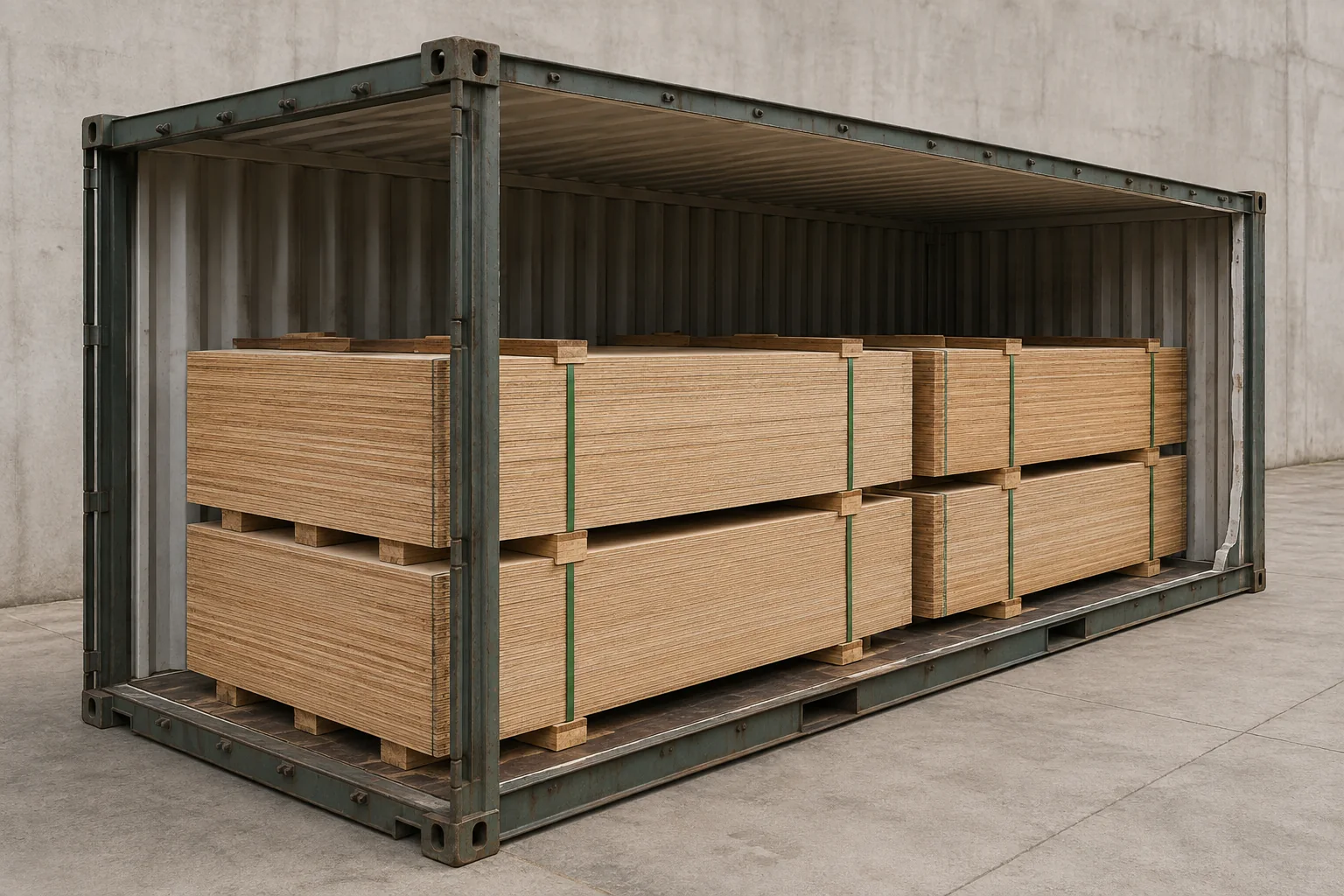
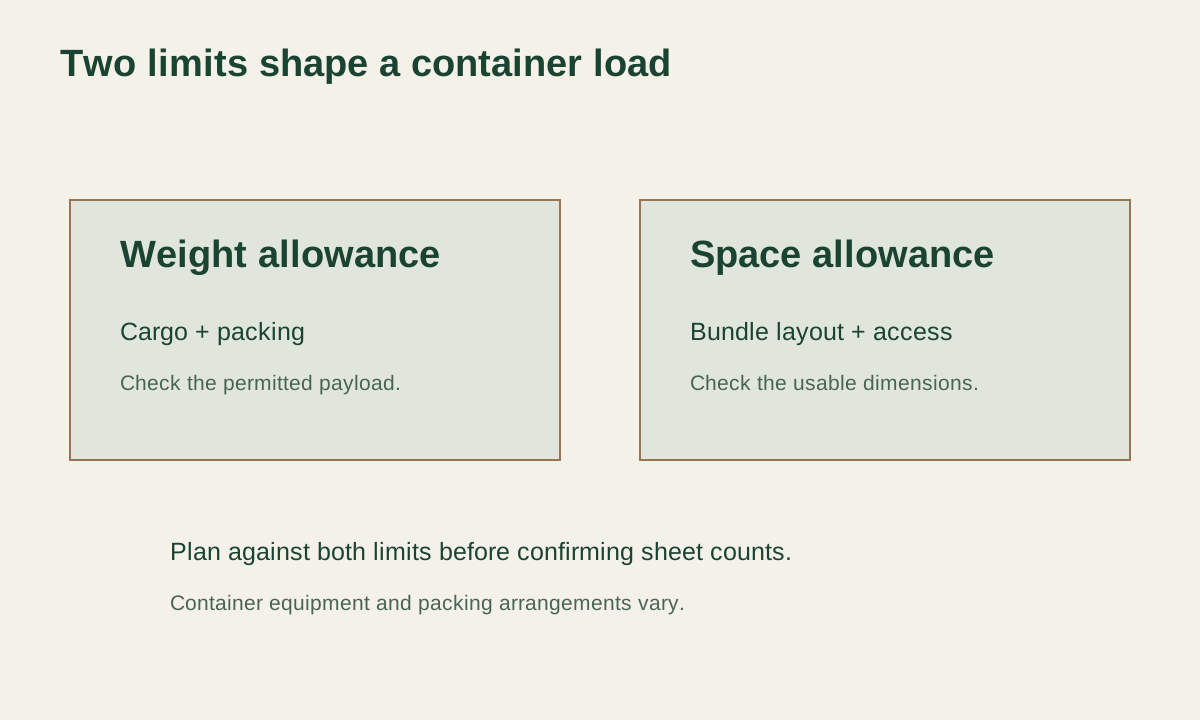
A plywood loading plan must satisfy three limits: the permitted cargo weight, the space available after packaging and the way full sheets actually fit through the door and inside the box. Dividing payload by sheet weight alone does not produce a safe sheet count.
| Container | Illustrative internal volume | Illustrative cargo payload |
|---|---|---|
| 20ft general purpose | 33 m³ | 28,000 kg |
| 40ft general purpose | 67 m³ | 26,500 kg |
| 40ft high cube | 76 m³ | 26,500 kg |
These are planning assumptions, not the rating of every container. Equipment varies by manufacturer and unit. Check the booked container's CSC plate, tare, door opening and internal dimensions, then apply the shipping line and destination road limits. Hapag-Lloyd's equipment specifications show why a single universal payload is unsuitable.
Weight and volume calculation
For a 2440 × 1220 mm sheet, panel volume is 2.44 × 1.22 × thickness in metres. Multiply this volume by the finished panel density to estimate its weight. The table uses an illustrative density of 650 kg/m³; use the actual agreed panel specification and weighment for an order.
The capacity-only ceiling is the smaller of payload divided by sheet weight and internal volume divided by sheet volume, rounded down. It excludes pallets, dunnage, securing materials, gaps and dimensional fit, so it is an upper bound, not a quantity that can necessarily be loaded.
| Thickness | Estimated sheet weight | 20ft capacity-only ceiling | 40ft capacity-only ceiling | 40HC capacity-only ceiling |
|---|---|---|---|---|
| 6 mm | 11.61 kg | 1,847 | 2,282 | 2,282 |
| 9 mm | 17.41 kg | 1,231 | 1,521 | 1,521 |
| 12 mm | 23.22 kg | 923 | 1,141 | 1,141 |
| 15 mm | 29.02 kg | 739 | 913 | 913 |
| 18 mm | 34.83 kg | 615 | 760 | 760 |
| 20 mm | 38.70 kg | 554 | 684 | 684 |
| 25 mm | 48.37 kg | 443 | 547 | 547 |
| 28 mm | 54.18 kg | 395 | 489 | 489 |
At this density, 28 tonnes of bare plywood occupies approximately 43.1 m³. That already exceeds a 33 m³ 20ft box, whatever the sheet thickness. In a 40ft box, 26.5 tonnes occupies approximately 40.8 m³, below its gross internal volume; dimensional fit and packing allowances still need checking. At a fixed density, thickness changes both sheet weight and sheet volume in the same proportion: it does not, by itself, switch a load from weight-limited to volume-limited.
Why whole-sheet geometry matters
Gross container volume is not usable sheet-stack volume. Two 1220 mm-wide sheets require 2440 mm across, which is wider than a typical dry container's roughly 2350 mm interior. The orientation, number of stacks, door height, loading method, floor loading and restraint plan can therefore reduce the count substantially. A plan for 1525 × 2440 mm boards must be laid out separately; dividing a smaller-board count by area alone is insufficient.
Palletised and loose-loaded plans differ. Deduct packaging weight from the applicable payload and its height and footprint from the available space. Use a demonstrated layout and the handling equipment available at both ends, then verify packed gross weight before dispatch.
Choose the container for the actual order
Compare the feasible packed quantity and freight quote for each container type. A high cube adds height but does not automatically add payload. A 28 mm container-flooring order needs the same checks as any other density and size; neither the thickness nor the container name guarantees a freight saving.
Request a reviewed loading plan
Send the sheet dimensions, thickness, finished density or measured weight, quantity, destination and discharge method. We will confirm the applicable payload, stack layout, packing allowances, sheet count and net and gross cargo weights with the quote. The container weight estimator can help with early planning; the agreed order still requires a loading plan.