
The three grades, in plain English
Indian plywood for packing and construction is broadly governed by two Bureau of Indian Standards specifications. The grade name tells you what glue line is inside the panel, and the glue line is what decides whether the panel survives a wet voyage.
IS 303 MR (Moisture Resistant)
Built with urea-formaldehyde (UF) resin. Designed for interior, dry-environment use — furniture, interior partitions, dry-warehouse packaging. Survives humid air and short-term moisture exposure. Will not survive standing water, repeated condensation cycles, or any salt-laden atmosphere. MR is the cheapest grade per square foot and the right answer for short-haul road movement of dry cargo inside India.
IS 303 BWR (Boiling Water Resistant)
Built with phenol-formaldehyde (PF) resin in a modified glue system. Passes a cyclic boiling water test — the panel goes into boiling water, comes out, dries, and is inspected for delamination. BWR is the workhorse export grade. It handles container condensation, monsoon transit, multi-modal handling, and the typical 20-to-35-day sailings to Middle East, Southeast Asia, and East Africa without breaking down. The chemistry is genuinely water-resistant, not just water-tolerant.
IS 710 BWP (Boiling Water Proof, Marine Grade)
Built to a stricter specification — PF resin throughout, denser core veneers, tighter veneer-grading, and the panel must pass a 72-hour boiling water test plus a mycological (fungal-attack) test. IS 710 is the true marine grade. It is over-specified for routine export packing and under-priced relative to the cargo it usually protects. The right answer for long-haul sailings, tropical-to-tropical lanes, deck-stowed containers, and any cargo where a claim event would dwarf the per-sheet premium.
What actually breaks MR-grade plywood at sea
Five distinct failure modes show up on inspection. They rarely arrive alone — one triggers the next.
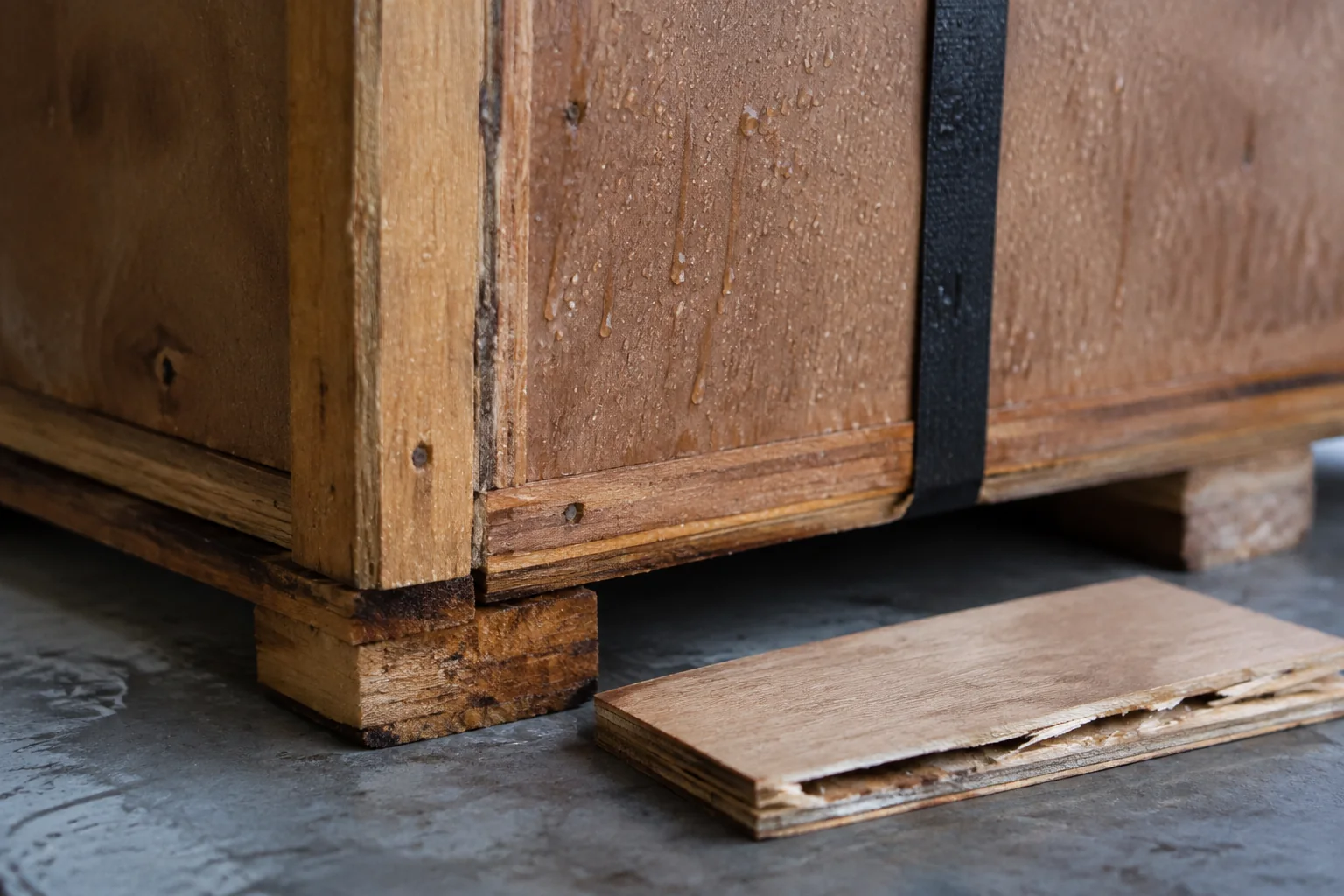
- Delamination. The UF glue line in MR plywood hydrolyses under repeated wet-dry cycles. The face veneer separates from the core, often invisibly at first, then in sheets when the crate is handled at the destination yard.
- Fungus blooming. Warm, damp, dark interiors of containers are an ideal substrate. MR panels carry no anti-fungal protection in the glue system. Black and white surface blooms appear within ten to fourteen days of sustained humidity above eighty percent.
- Fastener pullout. As the panel softens, nails and staples lose their grip. Side panels start to bow outward under their own cargo load. By the time the crate is forklifted, the joints are doing very little work.
- Dimensional creep. Wet plywood swells. Dry plywood shrinks back imperfectly. Across a 28-day voyage with diurnal cycling, the panels lose flatness, the crate goes out of square, and the cargo inside shifts.
- Surface blistering. The face veneer lifts in small bubbles where moisture has penetrated through micro-cracks. Cosmetic on day one, structural by week three.
The expensive part is not the failed crate. It is the cargo claim, the port-side rework, the demurrage while a replacement crate is built, and the buyer relationship that gets harder to rebuild.
Voyage duration and route — recommended grade by destination
The single best predictor of grade requirement is transit time, modified by the climate of the lane. The table below reflects typical sailing times from Cochin (Kochi) for full-container loads.
| Destination port | Typical transit | Lane climate | Recommended grade |
|---|---|---|---|
| Jebel Ali (UAE) | 6–9 days | Hot, dry, low rainfall | BWR for general cargo; BWP for sensitive equipment |
| Singapore | 8–12 days | Hot, humid, tropical | BWR baseline; BWP for trans-shipment cargo onward |
| Hamburg (Germany) | 22–28 days | Mixed, cold-wet at destination | BWR for dry cargo; BWP for machinery and pharma |
| Long Beach (USA West Coast) | 26–32 days | Pacific crossing, heavy condensation cycling | BWP recommended for full duration |
| Rotterdam (Netherlands) | 24–30 days | Atlantic crossing, wet European arrival | BWR for routine cargo; BWP for high-value |
The rule of thumb our packing operators use: under ten days in a dry lane, BWR is enough. Over twenty days, or anything routed through monsoon Southeast Asia, plan around BWP unless the cargo itself is low-value and replaceable.
The real cost delta
Here is where the conversation usually pivots, because the price difference looks larger on a sheet than it does on a shipment. The snapshot below reflects current ex-factory rates for 12mm sheets — GST and transport extra.
| Grade | Indicative rate (12mm, ₹/sq.ft) | Premium over MR |
|---|---|---|
| IS 303 MR (commercial packing) | On request | Baseline |
| IS 303 BWR (hardwood packing) | On request | Above MR; stated with the quote |
| IS 710 BWP (marine grade) | On request | Above BWR; stated with the quote |
For a standard 20-foot container packing job that consumes roughly 400 to 500 square feet of plywood, the upgrade cost is the grade premium applied to that area, and we quote it with the job. Set that against the value of the cargo and a single claim event, and BWR becomes the sweet spot for most export work — cheap insurance, real water resistance. BWP becomes the obvious answer the moment the cargo value crosses a threshold the exporter knows better than we do.
Decision matrix by cargo type
Grade selection is partly about route and partly about what is inside the crate. The matrix below is the short version of the conversation we have at quote stage.
| Cargo type | Recommended grade | Reason |
|---|---|---|
| Industrial machinery, capital equipment | BWP (IS 710) | Single claim dwarfs the grade premium; long lead-time replacements |
| Pharmaceutical APIs and finished goods | BWP (IS 710) | Anti-fungal glue system is mandatory for regulatory acceptance |
| FMCG and packaged consumer goods | BWR (IS 303) | Cost-sensitive, but cannot accept fungal contamination of secondary packaging |
| Electronics and electricals | BWP (IS 710) | Condensation on PCBs is unrecoverable; humidity tolerance is non-negotiable |
| Textiles, garments, leather | BWR (IS 303) | Stain risk from delamination; BWP only if shipped through monsoon lanes |
How to verify what you are actually getting
Grade-marking fraud is the unspoken background risk in this market. The defences are straightforward.
Look for the BIS standard mark and the IS number stamped on the back of every sheet — IS 303 for MR and BWR, IS 710 for BWP. The stamp should be legible, not smudged, and consistent across the pallet. Ask for the mill test certificate matching the batch. For high-value consignments, third-party lab testing is available at NABL-accredited facilities in Mumbai, Bangalore, and Chennai; the cyclic boiling test takes about a week and costs a few thousand rupees per panel. For repeat orders, audit one sheet per shipment as a discipline — suppliers behave better when buyers verify.
Tell us the lane, we will tell you the grade
Send us the destination port, the transit time on your booking, and a one-line description of the cargo. We will come back with the grade we would use, the rate, and the reason. If the answer is BWR rather than BWP, we will say so — over-specifying the panel does not serve anyone for long.