
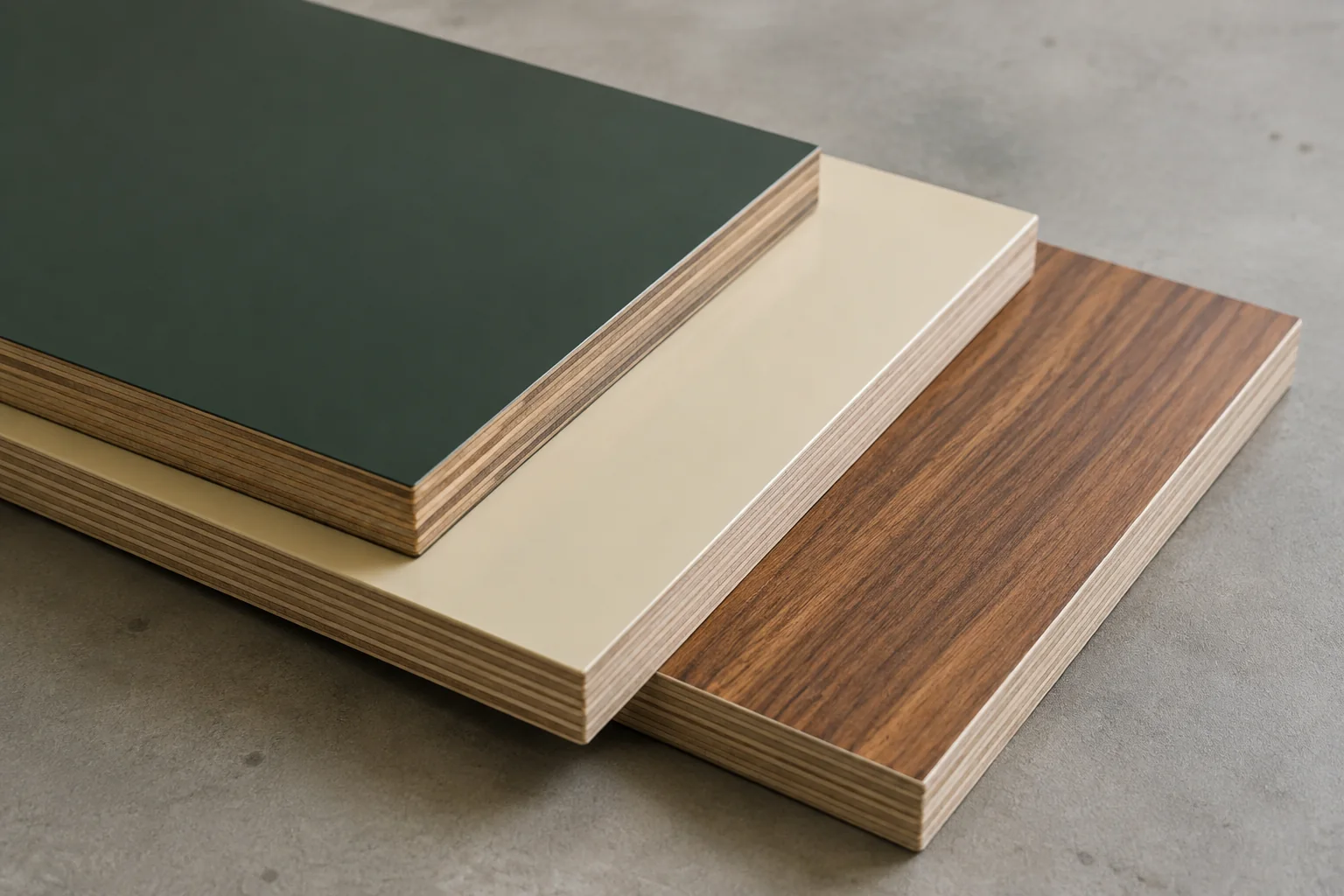
The three finishes, in one breath
When you specify decorative plywood for furniture or interiors, the show face is a separate decision from the board underneath. Three surface options cover most jobs, and they sit at different points on durability, cost and appearance.
- HPL (high-pressure laminate) — a thick decorative sheet, typically under ~1 mm and varying by grade (confirm to spec), pressed onto the board at high pressure. It is the most scratch- and moisture-tolerant of the three and comes in printed decors or solid colours. Post-forming grades exist for curved edges.
- Pre-laminated ("pre-lam", melamine / LPL) — a thinner decor paper factory-fused onto the panel at lower pressure. It is lighter and more economical than HPL, with a clean factory face, but it is less abrasion-resistant.
- Lacquer / PU coating — a liquid finish sprayed over a good natural face veneer. It shows the real wood grain, can be re-coated or repaired, and is chosen for the look rather than for outright toughness.
How they compare
| Factor | HPL | Pre-laminated (melamine/LPL) | Lacquer / PU |
|---|---|---|---|
| Surface toughness | Highest — scratch and abrasion resistant | Moderate — lighter-duty | Look-led, not toughness-led |
| Moisture tolerance | Best surface resistance (panel still depends on its substrate bond grade) | Moderate | Depends on coat and care |
| Relative cost | Highest | Economical | Economical to mid, varies with veneer |
| Appearance | Printed decor or solid colour | Printed decor | Real wood grain |
| Repair / re-coat | Replace the panel face | Replace the panel face | Re-coatable and repairable |
| Curved edges | Post-forming grades available | Limited | Follows the veneer |
HPL: when the surface takes a beating
HPL is the answer when the face has to survive real use — worktops, shutters, table tops, shopfitting, anywhere people scrape, wipe and lean on the panel daily. The decorative sheet is thick and pressed at high pressure, so it resists scratches and tolerates moisture better than the other two. Decors run from solid colours to printed wood and stone patterns, and post-forming grades let you wrap a curved edge.
The trade-off is cost and appearance: HPL is the priciest of the three, and the wood look is printed, not real. If the brief is hard-wearing and easy to clean, that is usually the right trade. We supply boards bare for in-house lamination, or already HPL-laminated — see our commercial plywood range for the substrate side.
Pre-laminated: the clean, economical factory face
Pre-laminated board arrives with a thin decor paper already factory-fused on at lower pressure. It gives a tidy, uniform finish straight from the panel, weighs less than an HPL build, and costs less. For wardrobe interiors, shelving, modular carcasses and back panels — surfaces that are seen but not pounded — it is often the sensible call.
Where it falls short is abrasion. Pre-lam does not take the same daily scraping as HPL, so it is the wrong pick for a heavily handled worktop or a high-traffic edge. Like HPL, the decor is printed, so it does not show genuine grain.
Lacquer / PU: the only finish that shows real wood
A lacquer or PU coating is sprayed over a natural face veneer, so the actual wood grain reads through. This is the finish for premium furniture, panelling and feature surfaces where the material itself is part of the design. It can be re-coated and spot-repaired over its life, which the laminated faces cannot — a damaged HPL or pre-lam panel is generally replaced, not refinished.
It is chosen for look and feel rather than brute toughness. A good coat protects the veneer, but the surface is not built to take the punishment an HPL face shrugs off. Pair the lacquer with a clean, uniform face veneer for the best result — our IS 710 vs IS 303 note explains how the bond grade underneath is a separate choice from the show face.
One number not to confuse: bare board vs finished thickness
The finish changes the panel's overall thickness, and that catches buyers out. A board quoted at, say, "16.5 mm" laminated is usually the finished thickness after HPL is pressed on — not the bare board. The bare substrate underneath is the nominal gauge; the laminate adds the rest. When you spec, compare quotes, or plan a load, be explicit about which number you mean: bare board thickness, or finished laminated thickness. We quote both on request.
How to choose, quickly
- Heavy use, moisture, easy cleaning — HPL.
- Seen but not pounded, budget-led, light weight — pre-laminated.
- Real wood grain, repairable, premium look — lacquer / PU over veneer.
The substrate matters as much as the surface: the same finish over a poor core will not perform. Confirm the board's bond and core alongside the finish, especially for anything that meets moisture. When you are ready, tell us the sizes, thickness, finish and quantity and our export desk will put the right build in writing, with test certificates and TDS to match.
FAQ
Which plywood finish is the most durable?
HPL (high-pressure laminate). Its decorative sheet is thicker and pressed at high pressure, so it resists scratches and tolerates moisture better than pre-laminated or lacquered faces. Pre-laminated is more economical but less abrasion-resistant, and lacquer is chosen for the look of real wood rather than outright toughness.
What is the difference between HPL and pre-laminated plywood?
HPL is a thick decorative sheet (typically under about 1 mm, varying by grade — confirm to spec) pressed onto the board at high pressure, giving the toughest, most moisture-tolerant face. Pre-laminated board has a thinner decor paper factory-fused on at lower pressure, which is lighter and more economical but less hard-wearing. Both use printed decors rather than real wood.
Which finish shows real wood grain?
Only a lacquer or PU coating. It is sprayed over a natural face veneer, so the genuine grain reads through, and it can be re-coated or repaired over time. HPL and pre-laminated faces use printed decors, so any wood look is a print, not the actual veneer.
Does the laminated thickness mean the bare board is that thick?
No. A figure like 16.5 mm on an HPL-laminated panel is usually the finished thickness after the laminate is pressed on, not the bare board underneath. The bare substrate is the nominal gauge and the laminate adds the rest. Always confirm whether a quoted number is bare board thickness or finished laminated thickness.
Can I get plywood supplied already laminated, or only bare?
Both. We supply boards bare for shops that laminate or lacquer in-house, and HPL-laminated with the decorative surface already pressed on, such as on the calibrated Okoume furniture grade. Tell us the finish, sizes, thickness and quantity and we will quote the right build with test certificates and TDS.