
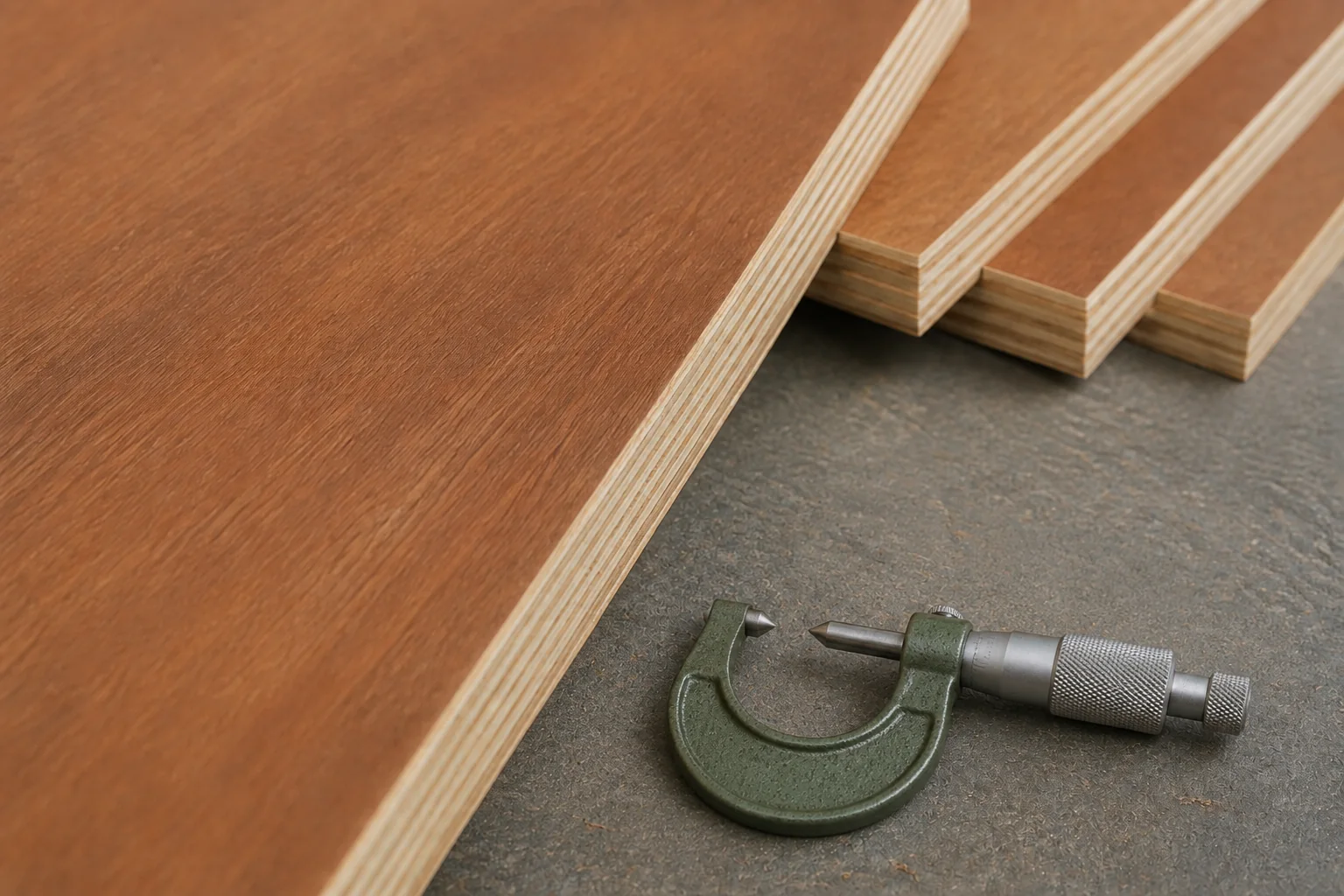
Short answer: calibrated Okoume furniture plywood is sanded to a tight thickness tolerance of about ±0.15 mm and carries an E1 low-formaldehyde rating. The calibration lets panels feed through CNC, edge-banding and lamination lines without shimming; the E1 class suits furniture and export markets with emission limits. It is worth the premium when your line runs automated machinery or your panels need a clean, uniform face for lacquer or laminate.
What "calibrated" actually means
Ordinary plywood is sold to a nominal thickness, but the real sheet can vary across its face and from sheet to sheet. A board labelled 16 mm might run a few tenths over or under. On manual work that variance is absorbed by hand. On an automated line it is not.
Calibrated plywood is sanded after pressing to a tight, consistent thickness — for our Okoume-faced furniture grade, about ±0.15 mm. Every sheet in the stack reads the same gauge. That is the whole point: the machine sees one thickness, not a range.
Why the tolerance matters on a production line
Tight tolerance shows up as fewer stops, less rework and a cleaner finished panel. Three places it pays off directly:
- CNC nesting and boring. Router depth and dowel-hole geometry are set once. A consistent gauge means the cut and the bore land where the program expects them, sheet after sheet.
- Edge-banding. The bander references the panel edge. Thickness drift causes glue-line gaps and proud or sunken bands that need sanding back. A calibrated edge feeds clean.
- Lamination and pressing. Even thickness gives even pressure across the platen, so the laminate or veneer bonds uniformly without thin spots or telegraphing.
If your shop still works panel by panel with hand tools, you will see less of this benefit. The tolerance earns its premium where machinery, not a person, is holding the reference.
Okoume is a face, not a bond
Okoume is the face veneer — smooth, uniform, pinkish-cream — that gives a clean surface for lacquer or laminate. It is not a bonding or moisture grade. The core and the glue line are specified separately. Our furniture grade pairs an Okoume face over a Eucalyptus core.
That distinction matters when you compare quotes. "Okoume plywood" tells you about the show face, not how the panel is built underneath. Always confirm the core and the bond alongside the face. For how the face options sit on our commercial range, see Okoume-faced commercial plywood; for the wider grade, see commercial plywood.
E1: the low-formaldehyde class
E1 is a low-formaldehyde-emission class. For furniture, fit-out and interiors — anywhere people live with the panel in a closed room — lower emissions matter. Several export markets also set emission limits, so the rating is often a gate to entry, not just a preference.
One caveat worth stating plainly: E1 meets the low-formaldehyde threshold many markets require, but stricter regimes are tighter than baseline E1. For markets such as CARB Phase 2 / TSCA Title VI in the US, or F★★★★ (F-four-star) in Japan, confirm the specific class you need and we will supply panels and mill test certificates to match.
A note on certification: the low-formaldehyde and emission certificates belong to the group and partner mills that press the panel, with test certificates and TDS provided. We supply the documentation; we do not claim the mill's certifications as our own.
Bare or HPL-laminated — and a number not to confuse
The grade is available bare or HPL-laminated. Bare board suits shops that laminate or lacquer in-house. HPL-laminated arrives with the decorative surface already pressed on.
One figure trips buyers up: a "16.5 mm" laminated sheet is the finished thickness after HPL, not the bare board. The bare board underneath is the nominal gauge; the HPL adds the rest. When you spec or compare, be clear which number you mean — bare board thickness or finished laminated thickness.
Reference spec and a quick fit check
A 16 mm Eucalyptus-core sheet runs about 32 kg, which works out to roughly 672 kg/m³ density — a solid, consistent panel, useful when you are planning container weights for an export load. Density varies with thickness and core, so it is confirmed on the TDS for your spec rather than assumed across the range.
Use this table to decide whether the calibrated grade is the right call:
| Your situation | Calibrated Okoume E1? |
|---|---|
| Automated CNC / edge-banding / lamination line | Yes — the tolerance pays for itself |
| Lacquer or laminate finish over a clean, uniform face | Yes — Okoume face suits it |
| Furniture or interiors, emission limits apply | Yes — E1 is the right class |
| Export market with formaldehyde limits | Yes — E1 plus mill test certificates (confirm class for strict regimes) |
| Hand-built, rough-carcass or hidden structural work | Often no — a standard grade may serve |
| Wet or exterior exposure as the main concern | No — specify a moisture-rated bond instead |
When a standard grade is the better buy
The calibrated E1 grade is not the answer to everything. If the panel is hidden structure, a rough carcass, or anywhere the face never shows and no machine references the thickness, a standard commercial grade usually does the job for less. And if your real concern is moisture or exterior exposure, that is a bond-and-core question — calibration and face veneer will not solve it. Match the grade to the actual job, and reserve the calibrated Okoume for the panels where tolerance and finish genuinely earn it.
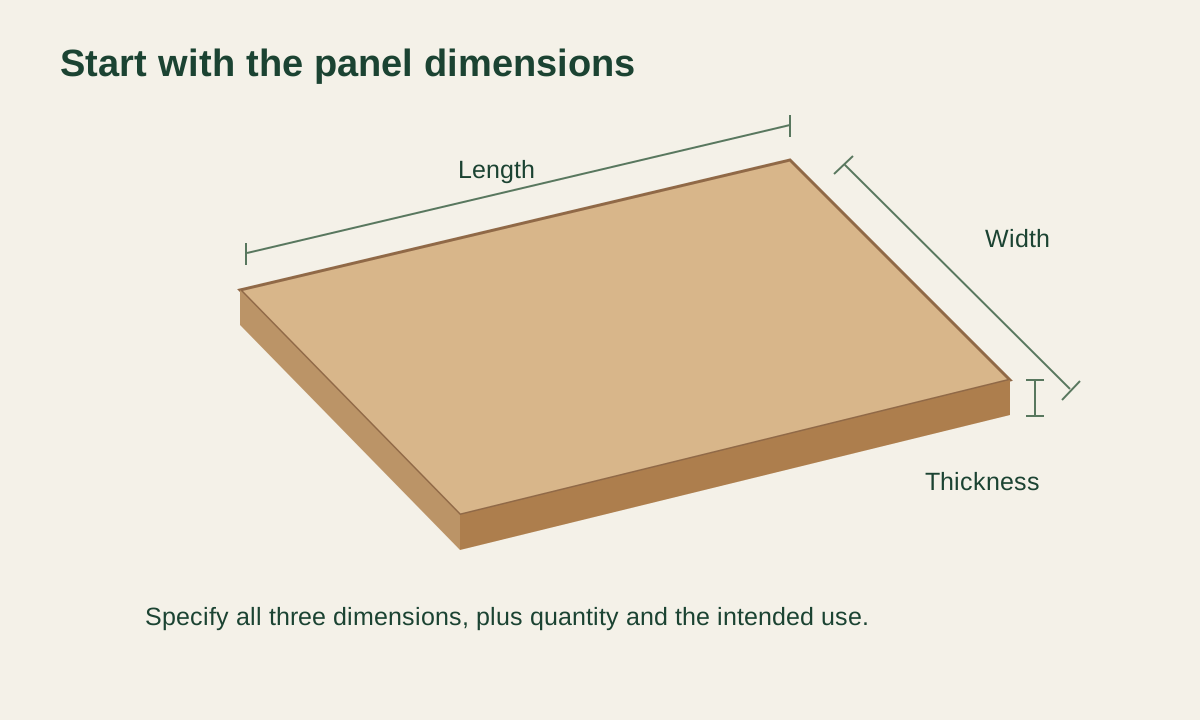
When you are ready to spec a job, tell us your sizes, thicknesses, bare-or-laminated, and quantity and we will put the right grade in writing.
FAQ
What thickness tolerance should I expect from calibrated Okoume plywood?
About ±0.15 mm for our furniture grade — tight enough to feed CNC, edge-banding and lamination lines without shimming. Ordinary plywood can vary more, which is what causes glue-line gaps and rework on automated machinery.
Is Okoume a type of plywood or a face veneer?
A face veneer. Okoume gives a smooth, uniform, pinkish-cream surface for lacquer or laminate, but it does not define the core or the bond — those are specified separately. Our furniture grade is an Okoume face over a Eucalyptus core. See our FAQ for more on grades and faces.
What does E1 mean, and why does it matter for export?
E1 is a low-formaldehyde-emission class. It matters for furniture and interiors where people live with the panel in closed rooms, and several export markets set emission limits that the rating helps you meet. For stricter regimes (CARB/TSCA Title VI, or F★★★★ in Japan) confirm the exact class; mill test certificates and TDS are provided.
Does the "16.5 mm" figure mean the bare board is 16.5 mm?
No. A 16.5 mm laminated figure is the finished thickness after HPL is pressed on — not the bare board. Always confirm whether a quoted number is bare board thickness or finished laminated thickness.
When is the calibrated grade not worth it?
When the panel is hidden structure or a rough carcass that no machine references and no one sees, a standard commercial grade usually serves for less. And if moisture or exterior exposure is your real concern, that is a bond-and-core decision, not a calibration one.