
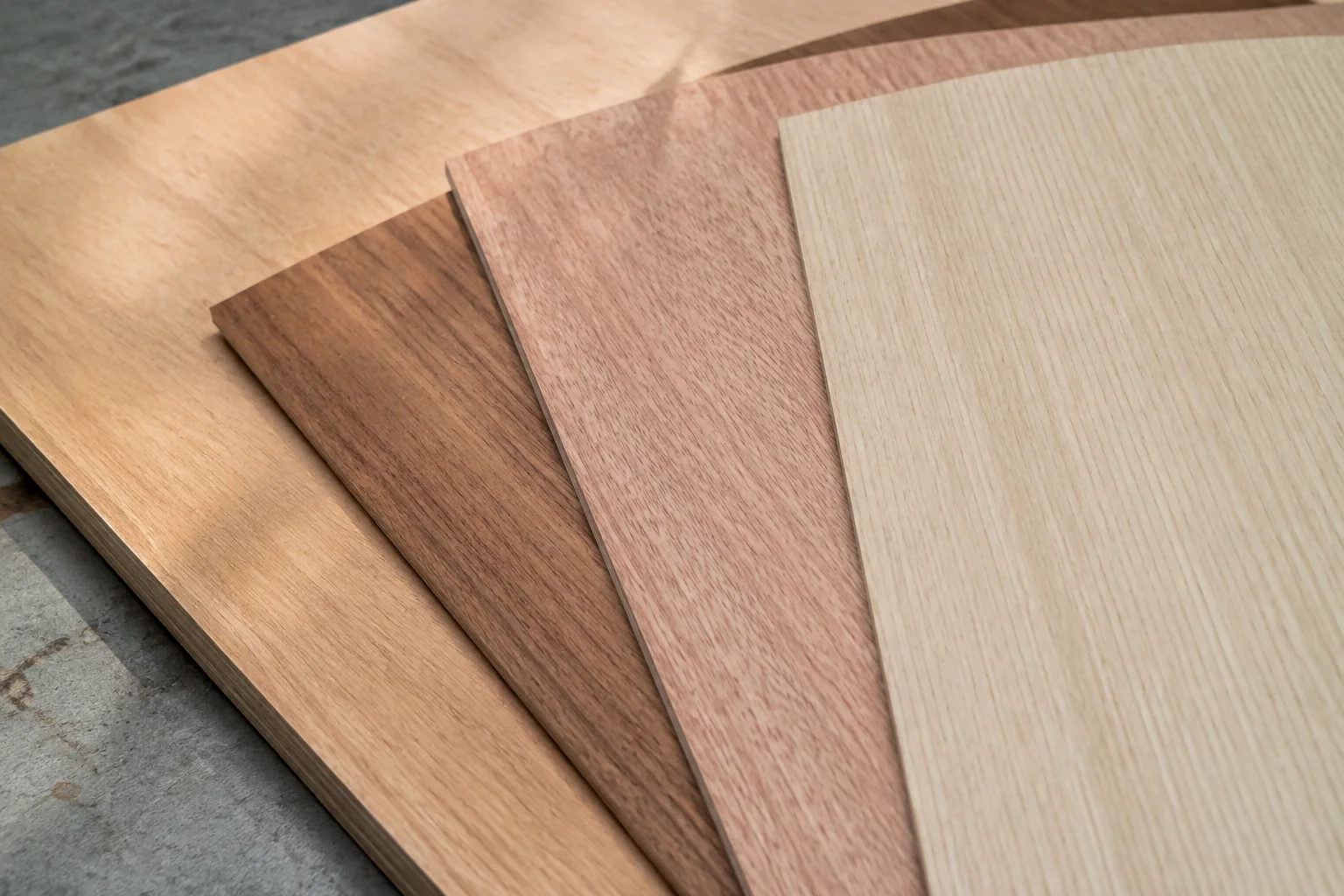
Quick comparison
| Property | Birch | Okoume | Gurjan |
|---|---|---|---|
| Density (kg/m³) | 650–680 | 410–450 | 720–760 |
| Modulus of rupture (MPa) | ~85 | ~55 | ~95 |
| Modulus of elasticity (GPa) | ~14 | ~9 | ~16 |
| Splinter rate (visual) | Very low | Low | Medium |
| Paint adhesion class | A (excellent) | A (excellent) | B (good with primer) |
| Surface evenness | Very smooth | Very smooth | Smooth to slightly textured |
| Relative cost (vs Gurjan baseline) | Highest | Mid | Baseline |
When to spec birch
Birch is the strongest of the three by a small margin and the smoothest surface. It's also the most expensive. Spec birch when:
- The buyer will paint, stencil or print on the crate face and needs first-time-right adhesion
- The cargo is fragile and any splinter risk is unacceptable (medical devices, optics, precision instruments)
- The destination market has visual-quality clauses in the purchase order (Europe, Japan)
- The crate will be reused — birch holds its surface through 5–8 handling cycles before showing wear
Birch is overkill for packing-case work where the crate is single-use and structural — that's where its premium isn't earned back.
When to spec okoume
Okoume is the lightweight option — significantly lighter than both birch and gurjan, which matters when crate weight pushes you into the next freight bracket. It's also visually clean and takes paint very well.
Spec okoume when:
- Weight per crate is close to a freight-rate threshold (40-foot HC limits, air cargo dimensional weight)
- The crate face will be branded or labelled and you need a clean print surface
- The cargo is moisture-sensitive and you're using IS 710 BWP grade — okoume face holds up well to the BWP cure
- The destination is humid (Gulf, Southeast Asia) — okoume's lower density means lower water absorption per unit thickness
Okoume's weakness is structural under impact. For heavy machinery exposed to rough handling, the lower MOR shows up as edge dents and corner splits more often than birch or gurjan.
When to spec gurjan
Gurjan is the workhorse face for export packing. It's the densest, the strongest under impact, the cheapest by ₹/sqft, and the most resistant to edge chipping. Its tradeoff is paint adhesion — gurjan has higher silica content, so paint and stencils need either a primer coat or roughening before they hold long-term.
Spec gurjan when:
- Cargo is heavy machinery, automotive parts, or anything where impact resistance trumps surface finish
- The crate will be lashed under deck — chafing exposure favours gurjan's higher MOE
- Budget pressure is real — gurjan is the cheapest of the three per sq.ft
- Customs in the destination market doesn't require visual-quality stamping on the panel face
The destination factor
European inspectors are stricter on face-veneer cosmetic defects than Middle East or African inspectors. We've seen Gurjan-faced packing crates flagged at Rotterdam for "splinter-prone surface" that would have cleared Jebel Ali without comment. If your buyer is in Northern Europe, default to okoume or birch face. If the buyer is in MENA, India-coastal or East Africa, gurjan is fine.
The thickness rule
Face veneer choice matters most at thinner panels. A 6 mm packing-case board is mostly face — on a 6 mm the face is most of what you are paying for, and switching from gurjan to birch moves the panel price more than any other choice on the spec; the quote states the difference. A 25 mm panel is mostly core — the face veneer on a 25 mm matters less, and gurjan is almost always the right call.
Practical guideline:
- 4–8 mm: the face is the largest single share of panel cost; choose deliberately
- 9–14 mm: the face is a much smaller share of panel cost; gurjan is the default unless surface matters
- 15–28 mm: the face is a minor share of panel cost; pick on durability not aesthetic
What we ship by default
For the Cochin Wood group's packing-grade range:
- Commercial / rubberwood plywood — gurjan face standard, okoume optional
- IS 710 BWP packing plywood — okoume face standard for export crating
- BWR hardwood plywood — gurjan face, optional birch for premium clients
If you need a different face on any grade, quote it on the order. Our manufacturing line accommodates birch, okoume and gurjan across all packing grades with 7–10 days lead time.