
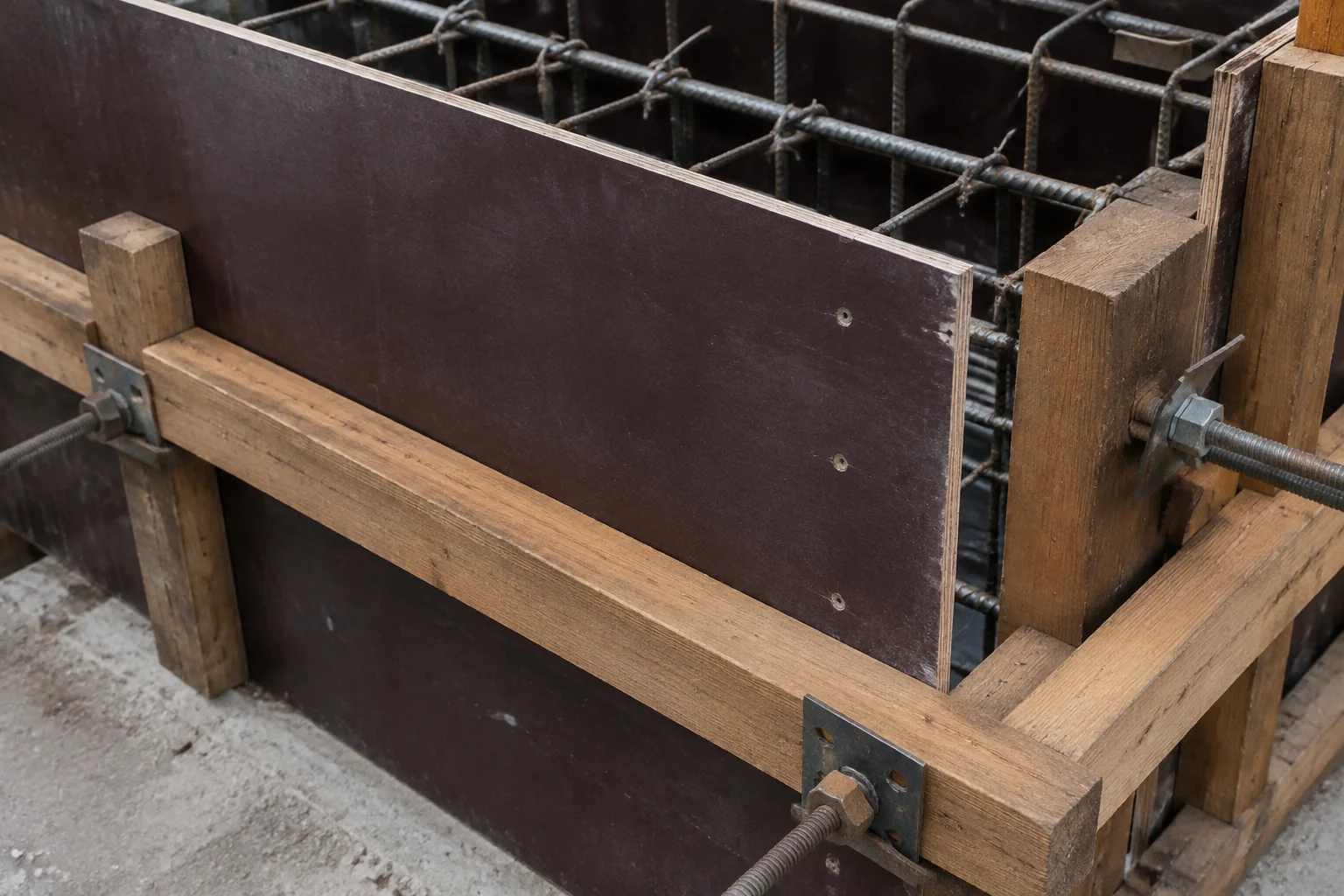
Shuttering plywood is bought by the sheet but consumed by the pour. Two contractors can pay the same rate for a panel and get completely different formwork costs — because one got twelve pours from it and the other got four. This guide is about making the buying decision the way the site economics actually work.
The only number that matters: cost per pour
Divide what you pay for a panel by the number of concrete cycles it survives in your conditions. That is the real price of your formwork skin. A film-faced panel that costs more per sheet than a plain board but lasts three times the cycles is not the expensive option — it is the cheap one. How many cycles to expect, and what kills panels early, is covered in how many pours film-faced plywood lasts.
Film-faced or unfaced: a decision rule
- Film-faced (HD shuttering plywood) — repeated pours, fair-faced or mirror-finish concrete, column and wall formwork, system formwork inserts. The phenolic film is what releases cleanly and protects the face between cycles.
- Unfaced shuttering board — single-use or low-count applications: foundations, footings, kickers, made-to-fit infill pieces where panels get cut up anyway.
Most sites need both. Ordering only premium film-faced board and then sacrificing it on footings is the most common waste we see on order sheets.
Thickness and panel size, by the formwork, not by habit
| Application | Typical thickness | Note |
|---|---|---|
| Slab decking on close-centred props | 12 mm | The workhorse thickness |
| Walls and columns, conventional formwork | 12–18 mm | Stud spacing decides; wider centres need 18 mm |
| System formwork replacement skins | Per system spec | Order to the frame's exact rebate; tolerance matters more than thickness |
| Curved and feature work | 6–8 mm, layered | Bent dry in multiple plies |
What the standard buys you
Shuttering plywood made to IS 4990 is built on boiling-water-proof bonding with construction rules written for concrete work. If a quote just says "shuttering ply" with no standard and no bonding grade, you are buying the seller's opinion. What the standard actually requires — and what to ask for with each lot — is in our explainer on IS 4990.
Site habits that protect the buy
- Seal every site-cut edge — exposed core is where panels start dying.
- Use release agent even on film faces; it is the film's life insurance, not a substitute for it.
- Clean and flat-stack between cycles, off the ground, out of direct sun.
- De-nail with care: every torn face is a pour off the panel's life.
What to put on the order
Grade and standard, film type and weight if faced, thickness, panel size, quantity by use (decking, walls, infill), and the delivery schedule against your pour programme. Stage deliveries if storage is tight — panels age faster in a monsoon laydown yard than in the press.
FAQ
Is film-faced plywood worth it for a small builder?
If the same panels will see more than three or four pours — yes, on arithmetic alone. For one-off domestic work, unfaced shuttering board with sealed edges is usually the rational buy.
Can I mix thicknesses in one order?
Yes, and you should: 12 mm for decking, 18 mm for walls, plus a margin of cheaper board for infill. We split mixed thicknesses across a load as standard.
What density should shuttering plywood be?
Treat density as a proxy for the core, not a target in itself. Ask instead for the bonding grade, the construction standard and a per-lot test certificate.
How should I compare two shuttering quotes?
Put expected pours under each panel and divide. Then check both quotes state a standard, a bonding grade and a film weight. A lower rate with none of those stated is not a lower price — it is an unpriced risk.
What the Cochin Wood group recommends
Tell us the pour programme, not just a sheet count. Our desk quotes HD film-faced and unfaced shuttering board against the formwork plan — decking, walls, infill split out — so the premium board goes where the cycles are.
Send your formwork plan for a written quote, or see the Film-Faced Shuttering Plywood product page.