
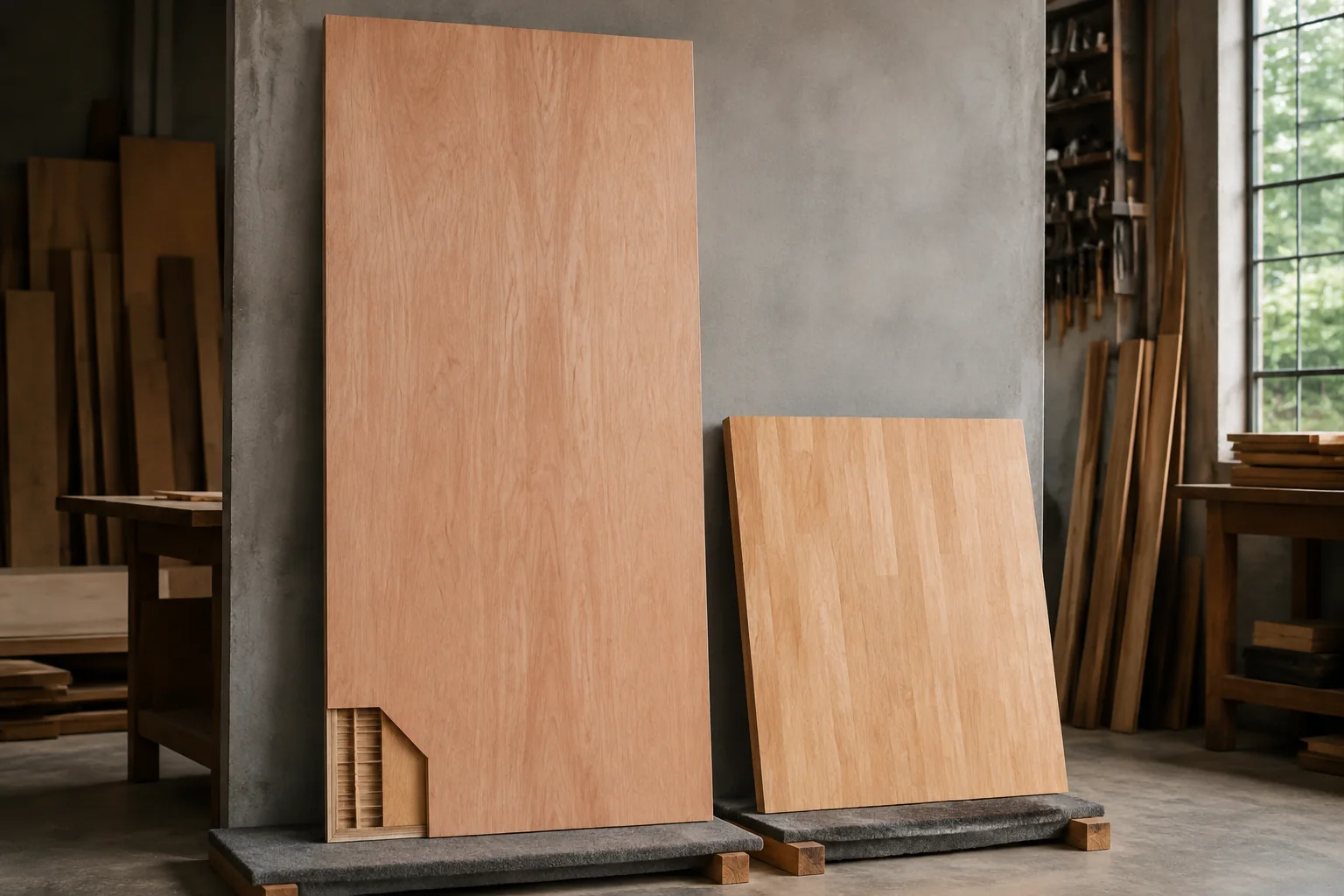
On institutional projects — hostels, hospitals, schools, offices — doors and panel cores are bought in hundreds, installed by subcontractors, and blamed on the supplier when they warp. Most of that grief is decided at the purchase order, long before site. Here is how to source flush doors and block boards so the last door hung looks like the first.
Translate the BOQ before you float the enquiry
A BOQ line that reads "35 mm flush door, commercial" leaves four decisions to whoever quotes lowest. Convert every door and panel line into explicit terms first:
- Construction — solid block-board core for doors that take hinges, locks and daily slams; the difference between core types is covered in block board vs plywood.
- Bonding grade — interior-dry areas can take MR; toilets, kitchens and ground-floor humidity call for BWR or better.
- Thickness and sizes — list every door size with its count; "as per schedule" invites substitution.
- Face and finish intent — paint-grade face or veneer/laminate-ready changes the face specification.
The standards line, in one sentence
For India-spec work, block boards are made to IS 1659 and solid-core flush doors to IS 2202. Putting those two codes on the order — with ISI marking where the project demands it, and a per-lot test certificate — converts a price comparison into a like-for-like comparison. That one sentence on the PO outranks any brochure claim.
Order in lots that match the install programme
Doors delivered eight months before hanging are doors stored badly. Split the order into install-phase lots, and ask the supplier to hold the later lots in production sequence rather than on your site. Two further rules:
- Acclimatise — doors should rest flat on a level base, in the building they will serve, for several days before hanging.
- Never store on edge against a wall — that posture is where most "manufacturing defect" warps are actually manufactured.
Inspect on delivery, not at installation
Per delivery lot, check a sample for: flatness across the diagonal, edge-strip continuity (lift points and lock zones), face sanding quality, squareness, and the lot's marking against the test certificate. A fifteen-minute gate check per lot settles in your favour every argument that would otherwise happen at handover.
Hardware reality check
Specify lock blocks and hinge reinforcement at order time if the hardware schedule is heavy — concealed closers and panic hardware ask more of a core than tower bolts. A good manufacturer builds to the hardware schedule; a trader sells what is in the godown.
FAQ
Block-board core or tubular core for project doors?
Solid block-board cores carry hardware and abuse better and are the default for institutional duty. Tubular and hollow cores save weight and cost on low-traffic residential leaves — a fair trade only when the duty is genuinely light.
Should project doors be BWR even indoors?
For wet areas and ground floors in humid climates, yes. For upper-floor dry interiors, MR-bonded doors built to standard serve well. Mixed orders — BWR for wet cores, MR elsewhere — are normal and worth pricing.
How do I compare two flush-door quotes?
Insist both state core construction, bonding grade, standard codes and edge-strip species. If one quote is silent on any of these, it is cheaper because of what it is not saying.
Can door sizes be non-standard?
Yes — made-to-order sizes are routine in project work. Custom dimensions are scheduled against the order and confirmed on the proforma invoice.
What the Cochin Wood group recommends
Send the door schedule and the hardware schedule together. Our desk prices block boards to IS 1659 and solid-core flush doors to IS 2202 with phenolic bonding, lot-marked and certificate-backed, delivered in phases that match the hanging programme.
Send your door schedule for a written quote, or see Block Boards & Flush Doors.