
How we export: process, documents and compliance
How we work
Five steps from enquiry to a sealed container, loaded 40 km from Cochin Port. Here is what happens at each step, what you receive, and when.
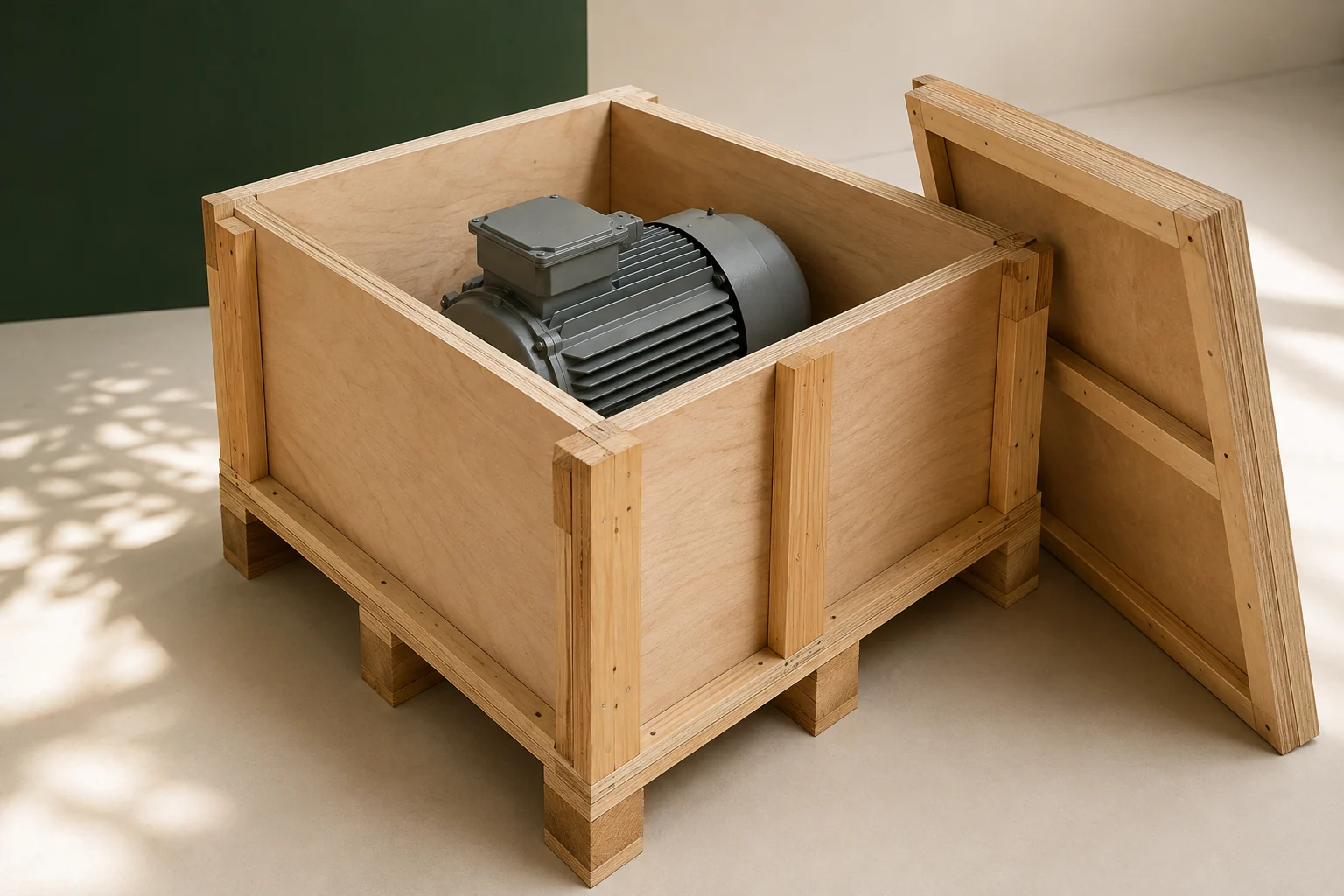
From enquiry to container in five steps
We make the plywood we export in our factories in Perumbavoor, where our group began working timber in 1986. The export desk runs the same way: to the spec, on the schedule, container after container. The path from first message to sailing is five steps.
| Step | What happens |
|---|---|
| 1. Spec confirmation | Choose the base family, such as commercial / packing plywood or an interior plywood, then state thickness, sheet size, grade and face veneer, plus quantity and destination port. |
| 2. Proforma invoice | FOB Cochin, in USD. Sheets per container, net and gross weights, production lead time and payment schedule, all in writing. |
| 3. Production and inspection | Panels pressed in our factory to the approved spec. An inspection window is held open before loading — come yourself or send a third-party agency. |
| 4. Loading at our factory | Containers are stuffed at our factory, about 40 km from Cochin Port. You get photos and video of your container as it loads. |
| 5. Documents and dispatch | The full document set is emailed on sailing. Originals follow by courier or through the bank, per your payment terms. |
Commercial terms
Export quotes are in US dollars, under Incoterms 2020, and always name the place or port the term applies to. Which term is right depends on how the goods are handed over.
| Order type | Payment terms |
|---|---|
| Standard products | 50% advance with the order, balance before dispatch |
| Custom specifications | 100% advance with the order |
Payment by bank transfer (T/T). For how thickness, grade and freight build into a landed cost, see the plywood price guide — export quotes are built per enquiry against current rates, so confirm before ordering.
FCA or FOB
FCA [named place] is normally the right term for a sealed container. Delivery and risk transfer happen when the container is handed to the carrier you nominate — at our premises once we have loaded your collecting vehicle, or at a Cochin terminal once the goods are there at the carrier’s disposal. We clear the goods for export. You contract the main carriage.
FOB Cochin applies where we are responsible for delivering the goods on board the vessel you nominate. Risk transfers when the goods are on board, and we carry the cost to that point. You contract the main carriage here too. We quote FOB on request.
Under Incoterms 2020 an FCA sale can still produce an on-board bill of lading: you instruct your carrier to issue one to us after loading. That has to be agreed in the booking, because the carrier is not obliged to do it.
Demurrage and detention are charged under the carriage, equipment and terminal contracts, not by the Incoterm. Who pays depends on who booked, the free time, and what caused the delay. The quotation states how origin delay, late vessel nomination, customs holds and late equipment return are allocated.
What you see before the container sails
You should not have to wait for the container doors to open at destination to know what is inside. Three things close that gap.
- Pre-shipment inspection. Welcome, by you or any third-party agency you appoint. We hold the goods for inspection before loading.
- Loading photos and video. Your container, your goods, shot at the door as it loads. Sent the same day.
- Packing list with real weights. Net and gross weight per bundle and sheet counts per pallet — the same numbers declared to the shipping line.
Behind all three sits the warranty in our Terms: the goods conform to the grade and standard on the proforma invoice at the time risk passes, with the thickness, grade and construction confirmed on it.
Verifying us before you pay an advance
We ask for 50% with the order, or 100% on custom work. If you have not traded with us before that is a real risk to take, so here is what you can check independently, and what we will send before you commit.
The legal seller. Cochin Wood Industries Private Limited, incorporated 10 December 2021 in Kerala, India. Principal place of business, as on the GST certificate: 15-236/B, Thoppilan Building, Vattakattupady, Rayamangalam, Perumbavoor, Ernakulam, Kerala 683542, India. Directors: Edwin David and Ambily Anu Isaac.
Registrations you can check yourself, without asking us. All of this, with the portal for each one, is also on a single page you can forward to your compliance team: cochinwood.in/company-verification.
- IEC AAJCC9689H — our Importer-Exporter Code, issued by the DGFT office at Kochi. Verify it at dgft.gov.in under Services, View Any IEC Details.
- RCMC/FIEO/10262/2024-2025 — Registration cum Membership Certificate from the Federation of Indian Export Organisations, for wood and articles, valid to 31 March 2029. It registers Cochin Wood Industries Private Limited as a merchant exporter; that term is printed on the certificate. The company invoices and exports, and the plywood itself is made in our factories in Perumbavoor, as set out under Who makes the goods below.
- LEI 98450010B744B73B1445 — our Legal Entity Identifier, searchable on the GLEIF database at gleif.org. Useful if your bank runs a counterparty check.
- CIN U20219KL2021PTC072862 on the MCA portal and GSTIN 32AAJCC9689H1Z5 on the GST portal.
Who makes the goods. We are the manufacturer. Your order is made in our factories in Perumbavoor, Kerala; the factory is named on the quotation, and you are welcome to visit it or send your own inspector. Cochin Wood Industries Private Limited is the company that invoices and exports. Where a BIS licence applies, your grade is made under the BIS licence of our factory that presses it, and the licence number is named on your quote so you can check its status and scope in BIS Care yourself.
Payment. The bank beneficiary name always matches the legal seller named on the proforma invoice. If you are ever sent bank details in which it does not, or which arrive by a channel other than the signed proforma invoice, stop and call the number on this site before remitting anything.
Before the container sails. You, or any inspection agency you appoint, may inspect the goods before loading, at your cost, on three business days notice. We hold the goods for it. We also send loading photographs and video of your container at the door, and we keep counter-samples of the approved grade.
If it goes wrong. Clause 14 of our Terms sets out shortfall refunds, the latent-defect window, the ten-business-day remedy decision and the return of any advance not earned if force majeure cancels the order.
Ask the export desk for the company documents pack if your onboarding process needs it.
Documents we provide
The standard set, with every shipment:
| Document | Purpose |
|---|---|
| Commercial invoice | Declared value and terms for customs at both ends. |
| Packing list | Bundle-wise net and gross weights and sheet counts. |
| Bill of Lading | Title document from the shipping line — surrendered or original, per your payment terms. |
| Certificate of Origin | Chamber-certified proof of Indian origin for destination customs, included where the destination, bank or contract requires it. |
| Treatment, fumigation and phytosanitary certificates | A treatment certificate where the quotation states it, a fumigation certificate only where fumigation was actually carried out, and a phytosanitary certificate where the destination requires one — confirmed against your country’s rules at PI stage. |
Tell us your customs broker’s checklist when you confirm the order. Destination-specific documents are agreed before production ends, not after the container sails.
Compliance: ISPM-15 and emissions
Three points export buyers ask about, answered straight.
- ISPM-15 packing. Solid-wood packing — pallets, runners, bearers — is treated and IPPC-marked to ISPM-15 by a DPPQS-registered treatment provider where the destination requires it; the treatment method follows the destination’s rules, and a treatment certificate is supplied where the quotation states it.
- Plywood itself is exempt. Plywood is processed wood under ISPM-15, so the panels need no treatment stamp. Only the solid-wood packing around them does, and ours carries it where the destination requires it.
- E1 glue line. A low-emission E1 glue line is available on Okoume-faced panels for markets and end uses that require it.
Cores are rubberwood and eucalyptus; faces are Okoume or Gurjan. The species detail is on Woods We Use.
Container weights that clear the destination
Which limit a container reaches first depends on the container, the panel density, the sheet layout and the road limit, not on sheet thickness alone. At the 650 kg/m³ planning density in our container loading guide, filling a 20 ft box’s 33 m³ takes about 21.5 tonnes of plywood, less than its 28-tonne payload. A 40 ft box at about 26.5 tonnes uses roughly 41 of its 67 m³ of gross volume, but sheet layout, door height and packing can still set the count first, so either limit may govern. We load every container within the lower of the ship-line payload and the destination road limit, check that the sheets fit and state the actual count on the proforma invoice, so your boxes are never stopped at a weighbridge after arrival.
| Destination | Approx. 40 ft load |
|---|---|
| Ship-line payload (general) | about 26.5 tonnes |
| Israel | about 24.5 tonnes |
| USA | about 20 tonnes |
Figures are approximate and confirmed per booking on the proforma invoice. Sheet counts per container follow from these caps and the loading layout — the arithmetic — payload caps, sheet weights and worked 40 ft loadings — is on the container weight guide.
Start with the spec
We ship to 28 countries across six continents: Sri Lanka, Turkey, the UAE, Saudi Arabia, Qatar, Oman, Kuwait, Bahrain, Israel, Vietnam, Bangladesh, Malaysia, Singapore, the Maldives, South Africa, Nigeria, Kenya, Tanzania, Mauritius, the Netherlands, Germany, the United Kingdom, the United States, Haiti, Puerto Rico, the Dominican Republic, Chile and Australia — and India domestically. Country-specific terms are on the export pages, including UAE and Israel.
Send thickness, sheet size, grade and monthly quantity. A proforma invoice follows in writing — FOB Cochin, in USD.
Common questions
What are Cochin Wood Industries' export payment terms?
Standard products: 50% advance with the order and balance before dispatch. Custom specifications: 100% advance with the order. Export quotes are in US dollars under Incoterms 2020, and always name the place or port: FCA Cochin where a sealed container is handed to your carrier, FOB Cochin where we deliver on board, CFR or CIF where agreed.
What export documents does Cochin Wood Industries provide?
Every shipment carries a commercial invoice, a packing list with net and gross weights and the Bill of Lading. A Certificate of Origin is included where the destination, bank or contract requires it. A treatment certificate is supplied where the quotation states it, a fumigation certificate only where fumigation was actually carried out, and a phytosanitary certificate only where the commodity or destination rules call for one — for regulated wood packaging the authorised ISPM-15 mark is normally the evidence, not a separate certificate.
Is plywood subject to ISPM-15?
No. Plywood is processed wood and exempt under ISPM-15. Solid-wood packing such as pallets, runners and bearers does fall under the standard, and the solid-wood packing Cochin Wood Industries ships is treated and ISPM-15 marked by a DPPQS-registered treatment provider where the destination requires it.
Can I inspect my plywood order before shipment?
Yes. Pre-shipment inspection is welcome, by the buyer or any appointed third-party agency, before loading at our factory 40 km from Cochin Port. Buyers also receive photos and video of their container as it loads, plus a packing list with net and gross weights.
How much plywood is loaded into a 40 ft container?
Containers are loaded within the lower of the ship-line payload and the destination road limit, for example about 24.5 tonnes into a 40 ft for Israel and about 20 tonnes for the USA, so containers clear destination weighbridges.