
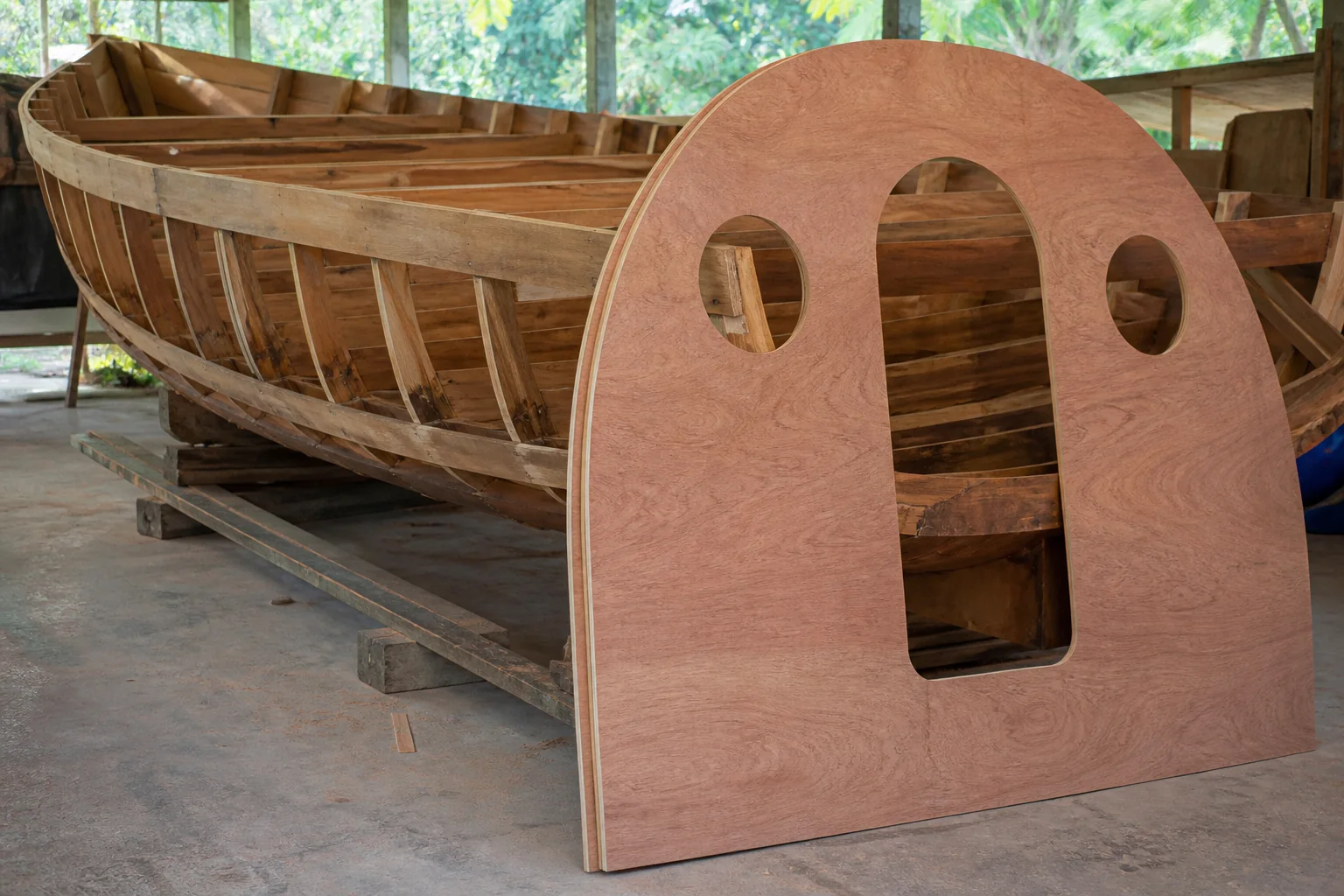
Marine plywood is the most counterfeited claim in the panel trade. Every coastal timber market sells boards called "marine" that have never met a phenolic resin. For a boatyard, the cost of believing the label is a hull liner that delaminates in season two. This is the verification routine to run before the order — not after the failure.
What "marine" must mean on your order
In India-spec terms, marine plywood is BWP-grade board built to IS 710: phenol-formaldehyde bonding throughout, higher-density construction, and survival of prolonged boiling-water testing. The order line should say exactly that — "BWP marine plywood to IS 710" — because each word closes a substitution door. How IS 710 differs from ordinary commercial standards is in IS 710 vs IS 303.
Five checks before you confirm the order
- Per-lot test certificate. Not a framed certificate on the office wall — a certificate for the lot you are buying. Manufacturers who test by lot can hand it over without ceremony.
- ISI marking. Boards marked under licence to IS 710 carry traceability that a stencilled "MARINE" never will.
- Core inspection on a cut edge. Ask for one board cut: look for core gaps, overlaps and thin plies. A marine board's edge looks like a book of even pages.
- The boil test, literally. A cookpot, an offcut, a few hours at a rolling boil and a prying knife at the glue lines. Crude, decisive, and exactly what the standard formalises.
- Weight in the hand. Phenolic marine board is noticeably denser than commercial ply of the same thickness. Suspiciously light boards are answering your question early.
Match thickness to the job, not to the budget
Hull work, decking, bulkheads, transoms and interior fit-out each carry their own thickness logic — and getting it wrong in either direction costs money or weight. Rather than repeat the schedule here, use the marine plywood thickness guide and bring the answer back to your order sheet.
Storage and fabrication habits that protect the spend
- Flat-stack on level bearers under cover; marine board tolerates water, not careless storage curvature.
- Seal every cut edge and fastener bore with epoxy before assembly — the standard certifies the panel, not your saw cuts.
- Pair the board with marine-duty fasteners and bedding compounds; a certified panel around a rusting screw is still a failure.
FAQ
Is BWP the same as marine plywood?
BWP describes the boiling-water-proof bonding grade; marine plywood is BWP-grade board built and tested to the marine standard's full construction requirements. All marine ply is BWP; not every board sold as BWP was built to IS 710.
Can I use marine plywood for furniture?
Yes — it is overqualified but excellent, and common for bathroom and outdoor furniture. The reverse substitution is the dangerous one.
Does marine plywood need painting or sealing?
The bonding survives water; the faces and your cut edges still want a finishing system. Treat coating as part of the build, not a sign of weak board.
What warranty should I expect?
A manufacturer's warranty against delamination and borer attack, conditions stated in writing, with the period confirmed on the proforma invoice. Be wary of warranties that no document anywhere records.
What the Cochin Wood group recommends
Run the five checks on every new supplier — ours included. Our BWP marine plywood is built to IS 710 with per-lot test certificates supplied on request, and we will cut a board for your edge inspection without being asked twice.
Tell us the build — hull, deck or fit-out — for a written quote, or see BWP Marine Plywood.