
Your 28-crate shipment to Hamburg gets held in customs because one IPPC stamp looks faded. The buyer is calling. The line is at risk. What can you do at the port, and what should you have done before the container left Cochin? This is the question that arrives in our packing desk inbox more often than any other from engineering and pharma exporters shipping out of South India.
The short answer is that ISPM-15 compliance does not expire on a calendar, but the stamp on the wood can absolutely lose its standing the moment a crate is opened, repaired, or fabricated from mixed-origin timber. The longer answer is a decision tree that every export packing manager should keep on the wall. Drawing on group operations going back to 1986, here is how Cochin Wood Industries handles HT stamp validity and re-stamping for FOB Cochin shipments in 2026.
What ISPM-15 actually requires (brief refresher)
ISPM-15 is the International Plant Protection Convention standard that governs solid wood packaging material used in international trade. It exists to stop the cross-border spread of wood-boring pests. Compliance is mandatory in over 180 countries, and the rules apply to crates, cases, pallets, dunnage, drums, and skids built from solid wood thicker than 6 mm.
There are two approved treatments. The first is heat treatment (HT), where the wood core reaches a minimum of 56 degrees Celsius for at least 30 continuous minutes. The second is methyl bromide fumigation (MB), now phased out in most EU and East Asian destinations on environmental grounds. Once treated, the wood must be marked with the IPPC stamp showing the country code (IN for India), the registered facility number, and the treatment code (HT or MB).
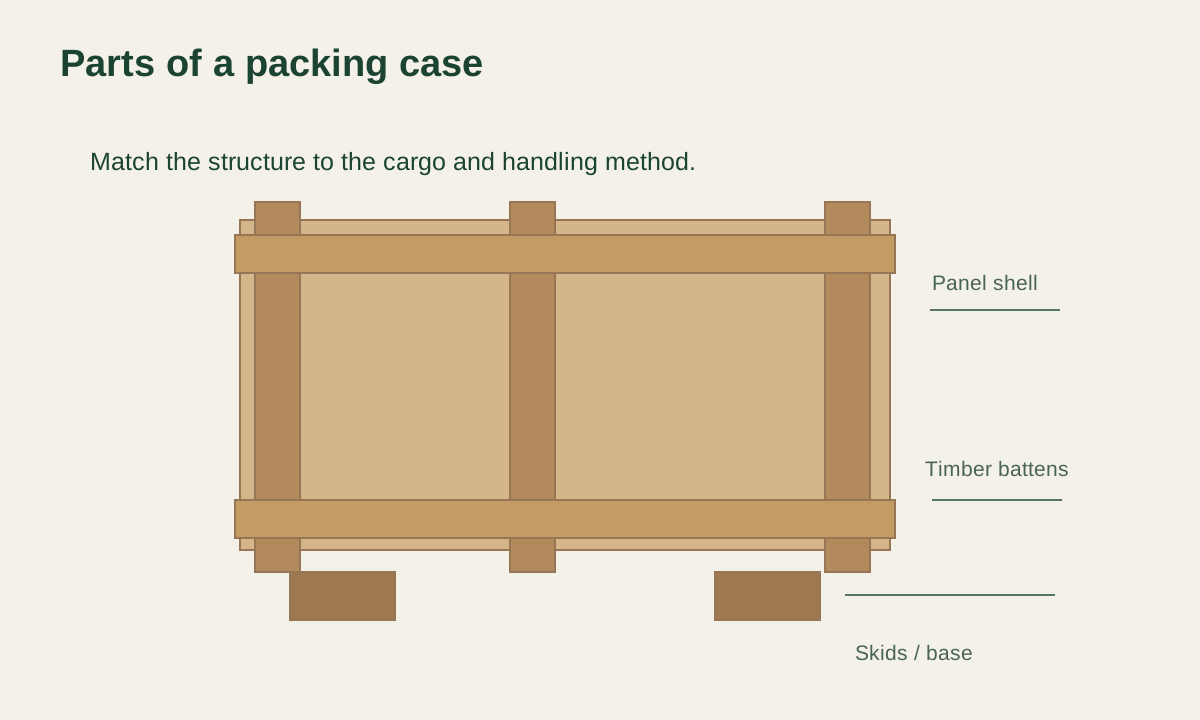
Plywood, OSB, particle board, and other engineered panels are exempt from ISPM-15 because the manufacturing process already neutralises pests. This matters: a crate built entirely from plywood walls and a plywood base does not need an IPPC stamp at all. The stamp is only required where the crate uses solid wood framing, runners, or skids.
When the HT stamp loses validity
The stamp does not have an expiry date printed on it. What kills its validity is a change in the wood itself. Work through this five-question decision tree before any repaired or repurposed crate goes back into a container.
- Has the crate been opened and any solid-wood component replaced? If even one runner, batten, or skid has been swapped out with non-treated timber, the whole unit is no longer compliant. Re-treat the new component and re-stamp.
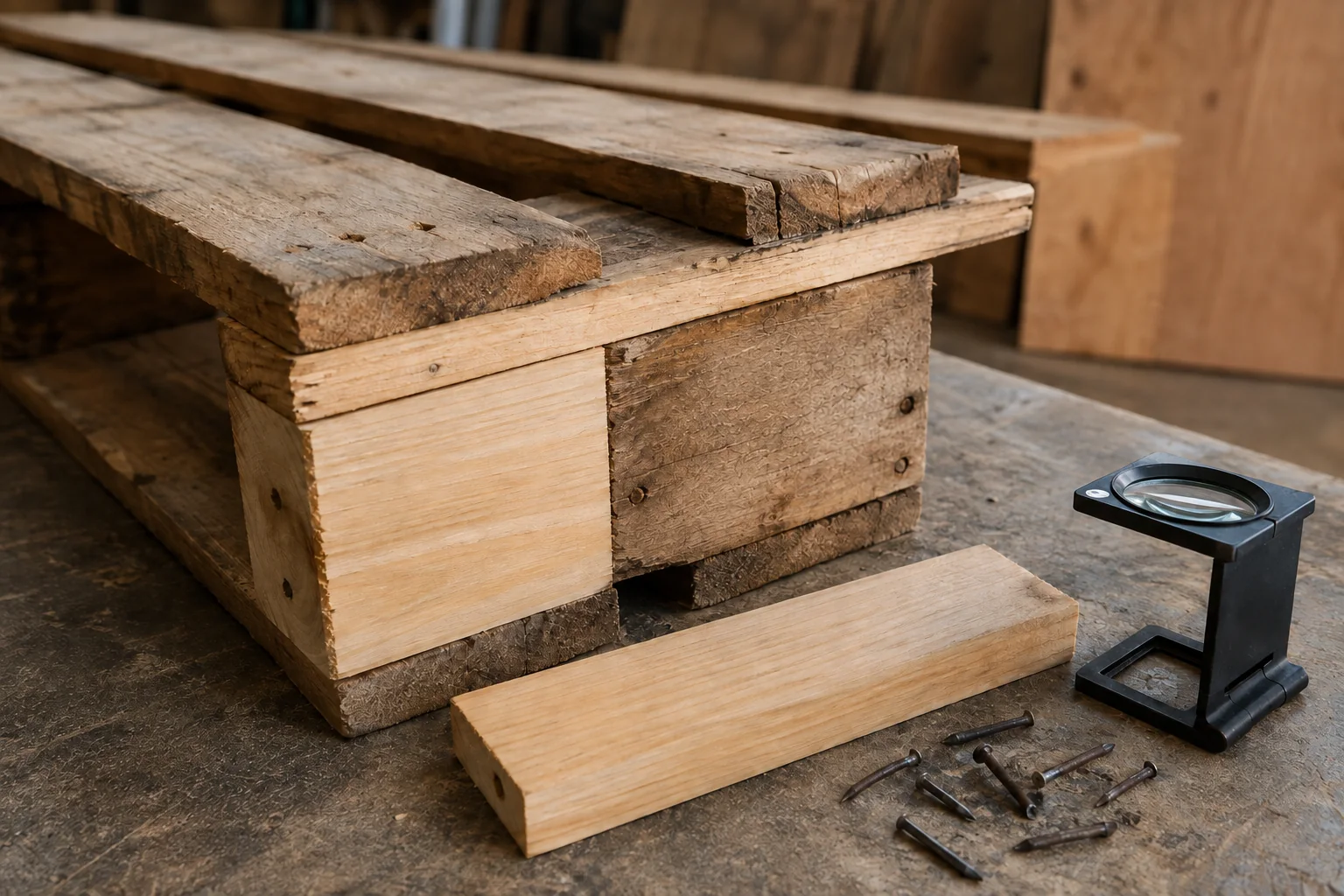
- Has the crate been repaired with timber from an unknown source? Workshop offcuts, second-hand pallets, and "spare wood from the yard" are the most common cause of customs rejections at European ports. Assume non-compliance unless the replacement piece carries its own visible IPPC mark.
- Has the original stamp been painted over, sanded, or damaged to the point of being unreadable? Customs officers reject crates where the country code, facility number, or HT code cannot be cleanly verified. A faded stamp is treated as no stamp.
- Has the crate crossed a border, been emptied, and is now being reused for an outbound shipment? Reused crates need a re-inspection. If the wood is intact and the stamp is clearly legible, it remains valid. If any plank has been replaced, treat as a new repair.
- Was the crate stored in conditions that allowed visible pest activity or fungal growth? Borer holes, frass, and active mould all trigger a fresh treatment requirement, regardless of how recent the original HT was.
If any answer above is yes, the crate must be re-treated and re-stamped by a registered facility before it can ship.
HT-IN registration workflow in India
Treatment and stamping in India are controlled by the Directorate of Plant Protection, Quarantine and Storage (DPPQS) under the Ministry of Agriculture. The registration is administered through accredited treatment providers approved by the National Plant Protection Organization (NPPO-India).
For an exporter who wants their own HT-IN facility number, the workflow runs as follows. The applicant submits Form A through the regional Plant Quarantine Station, attaches proof of heat-treatment chamber capacity (chart recorders, calibration certificates, chamber drawings), pays the prescribed inspection fee, and hosts a site audit. Once cleared, the facility receives a unique IN-numbered registration that becomes part of every stamp it issues. The end-to-end timeline in our experience runs four to ten weeks from a clean application, with fees varying by state and chamber size.
Most exporters do not run their own chamber. They route crates through an accredited third-party treatment yard, pay per cubic metre, and receive a treatment certificate referencing the chamber's IN number. This is the practical option for any exporter shipping fewer than two containers a week.
A note on documentation: all certificates and registration references are released to verified buyers on request. Treatment certificates should reference the consignment, the chamber chart trace for that specific batch, and the date of stamping.
Common customs rejection scenarios by port
Different destination ports apply ISPM-15 inspection with different degrees of strictness. The pattern below is what packing managers should brief into their costing assumptions when quoting FOB Cochin.
| Port | Most frequent rejection reason | Typical cost impact |
|---|---|---|
| Rotterdam | Stamp legibility — faded or partially sanded marks flagged on random inspection | Re-treatment at bonded yard plus 5 to 9 day demurrage |
| Hamburg | Mixed-timber repair where one replaced runner has no visible IPPC mark | Full container offload, inspection fee, and possible re-export of non-compliant wood |
| Jebel Ali | Bark residue on solid-wood components — bark is prohibited regardless of treatment | Crate-level rework at port; tolerated if caught early, fined if not |
| Singapore | Discrepancy between phytosanitary documentation and physical stamp facility number | Hold pending documentary clarification; typically 48 to 72 hours |
| Long Beach | Suspected live infestation triggering APHIS inspection | Mandatory re-export of the wood packaging at shipper cost; high penalty risk |
The takeaway: European ports prioritise the stamp itself, Middle East ports focus on bark, and US ports inspect for actual pest evidence. Every brief to a packing crew leaving Cochin should mention all three.
FOB Cochin doc checklist for ISPM-15 compliance
Before a container leaves the yard, the packing desk should have the following ready and cross-referenced to each crate number.
- Treatment certificate from the accredited HT facility, with chamber IN number and treatment date
- Photographic record of each crate showing the IPPC stamp position, country code, and legibility
- Phytosanitary certificate where the destination country requires one alongside the IPPC stamp
- Packing list keyed to crate numbers, dimensions, and net weights
- Material declaration confirming solid-wood components versus exempt engineered panels
- Bark-free attestation for crates destined for Jebel Ali, Dammam, or other GCC ports
- Repair log if any crate was refurbished, identifying which components were replaced and re-treated
- Container stuffing report with date, seal number, and IPPC compliance sign-off
- Buyer-specific export documentation as agreed in the purchase order
- Internal QC sheet with the packing supervisor's signature
All certificates are released to verified buyers on request, alongside the chamber chart trace where applicable.
When re-treatment vs replacement makes sense
The rule of thumb our packing desk applies is straightforward. If the structural integrity of the crate is intact and only the stamp is unreadable, re-treat and re-stamp at a third-party treatment yard; the yard sets its own charge by volume and location and states it on its invoice. Turnaround is typically 24 to 48 hours.
If more than 20 percent of the solid-wood content needs replacement, building a fresh crate is almost always cheaper than chasing piecemeal repairs. A new export-grade plywood-walled crate with hardwood framing for a one-cubic-metre engineering consignment often costs less than the labour of dismantling, sourcing matching timber, re-treating, and re-stamping a damaged crate once delay costs are included.
The exception is heavy machinery crates over three cubic metres, where the framing itself is a capital item worth preserving. There, targeted repair plus re-treatment is the right call.