
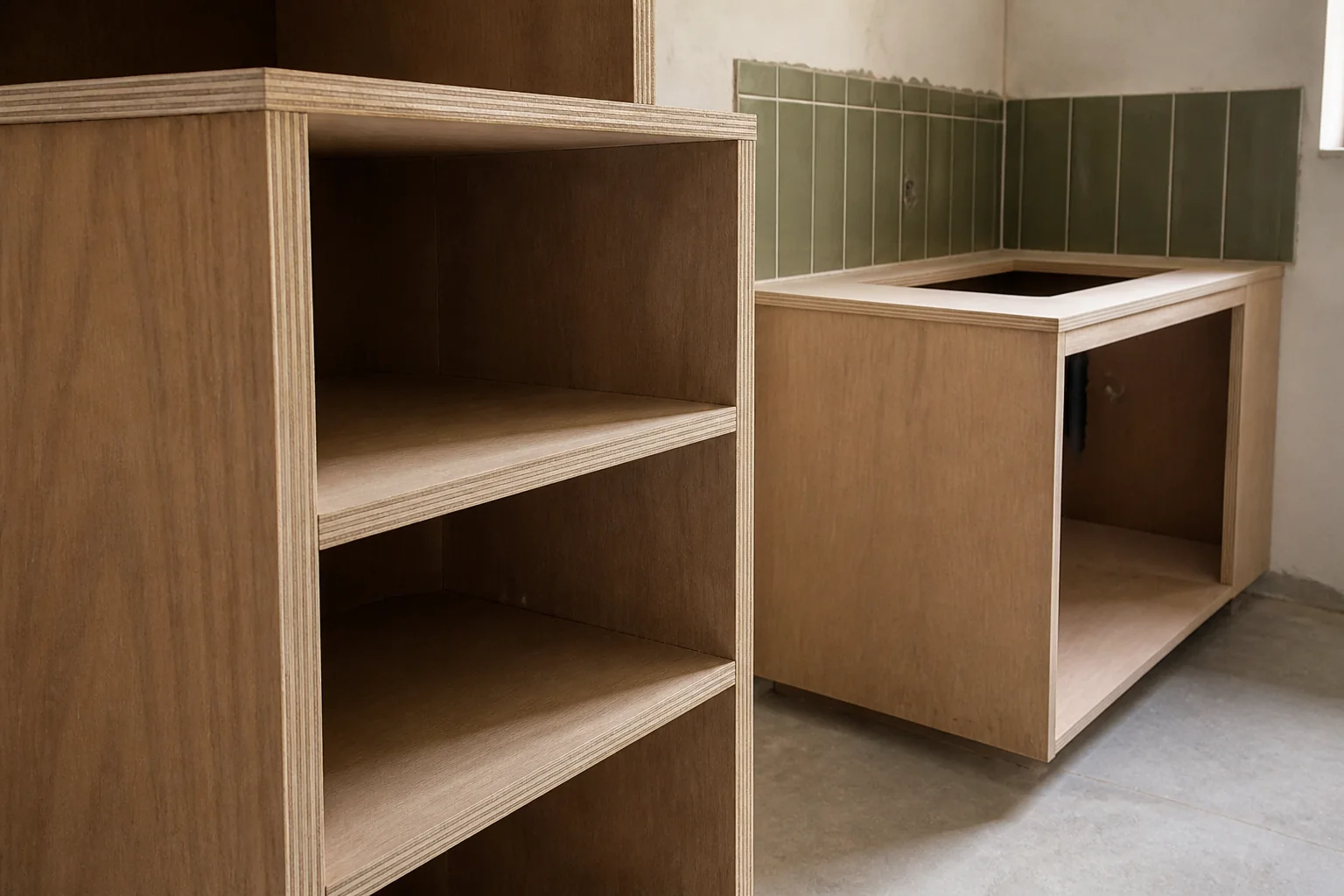
Every fitted-furniture fabricator carries the same scar: the kitchen carcass that came back swollen. The grade decision between MR and BWR plywood is small money at the order and large money at the callback. Here is the working decision rule we give joinery customers — by room, by component, and by what the callback actually costs.
The one-line chemistry, then the buying logic
MR is moisture-resistant urea-bonded board; BWR is boiling-water-resistant phenolic-bonded board. The resin chemistry and test regimes are covered in BWP and BWR plywood explained — this article is about which one to put on the cutting list.
Decision by room and component
| Application | Grade call | Why |
|---|---|---|
| Kitchen carcasses and sink units | BWR, no debate | Steam, spills and the sink trap live here; this is where MR fails publicly |
| Kitchen shutters and exposed fronts | BWR | Wipe-downs and steam reach fronts as surely as carcasses |
| Wardrobes, upper-floor bedrooms | MR serves well | Dry interior duty is what MR is for |
| Wardrobes against external or bathroom walls | BWR for backs and gables | The wall face sweats; mix grades within the unit |
| Bathroom vanities | BWR minimum | Standing water; consider marine-grade BWP for the sink panel |
| TV units, bookshelves, study furniture | MR | Paying BWR premium here buys nothing the room will ever ask for |
| Retail fit-outs | MR, BWR at floor contact | Mopping regimes attack kick plinths first |
The mixed-load order is the professional order
Fabricators who buy one grade for everything are subsidising either risk or waste. The order that matches the table above — BWR for wet rooms and contact surfaces, MR for dry casework — is routinely cheaper than all-BWR and immeasurably safer than all-MR. Mixed thicknesses and grades across one load are standard practice; ask for the split rather than rounding up.
Face veneer is a separate decision
Grade is the glue; the face is the finish. A BWR core can carry an Okoume face for stain-grade work or a plainer face under laminate. Choose the face by the finishing route — the comparison is in Okoume vs Gurjan face veneers — and never let a pretty face stand in for the bonding grade underneath it.
What to ask your supplier for
- The grade stated as MR or BWR on the invoice, per line item — not "commercial" as a catch-all.
- ISI marking to IS 303 where the project specifies it, and a per-lot test certificate on request.
- Consistent calibration if your shop runs edge-banders and CNC — tolerance is a spec, ask for it.
FAQ
Is BWR plywood waterproof?
It is boiling-water-resistant, not submarine-grade. BWR survives kitchen duty and humid climates; for sustained wetting, step up to BWP marine plywood.
Can I use MR plywood in a kitchen if it is laminated both sides?
Laminate slows moisture but every edge, hinge bore and screw hole is a doorway past it. The carcass that swells does so from the edges in. Use BWR.
What thickness for carcasses and shutters?
Common practice: 18 mm carcasses and shutters, 6–9 mm backs, 18–25 mm shelves depending on span. Span and hardware decide, not habit.
How much more does BWR cost than MR?
The premium varies with the market; we quote current rates on request. Judge it against the cost of one swollen kitchen revisit — the comparison rarely needs a calculator.
What the Cochin Wood group recommends
Send the room-by-room cutting list and let the order carry two grades. Our desk quotes MR and BWR commercial plywood to IS 303 — calibrated, face of your choice, mixed loads as standard.
Send your cutting list for a written quote, or see Commercial / Packing-Grade Plywood.