
What IS 10418 Covers
IS 10418 is the Indian Standard for plywood drums used for packing electrical cables. It is the dispatch-grade reference for the cable industry — what BIS uses when a buyer disputes a drum failure, what a third-party inspector measures against, and what most cable tenders cite in their packing clause.
The standard covers four structural elements of the drum, each with its own tolerance band:
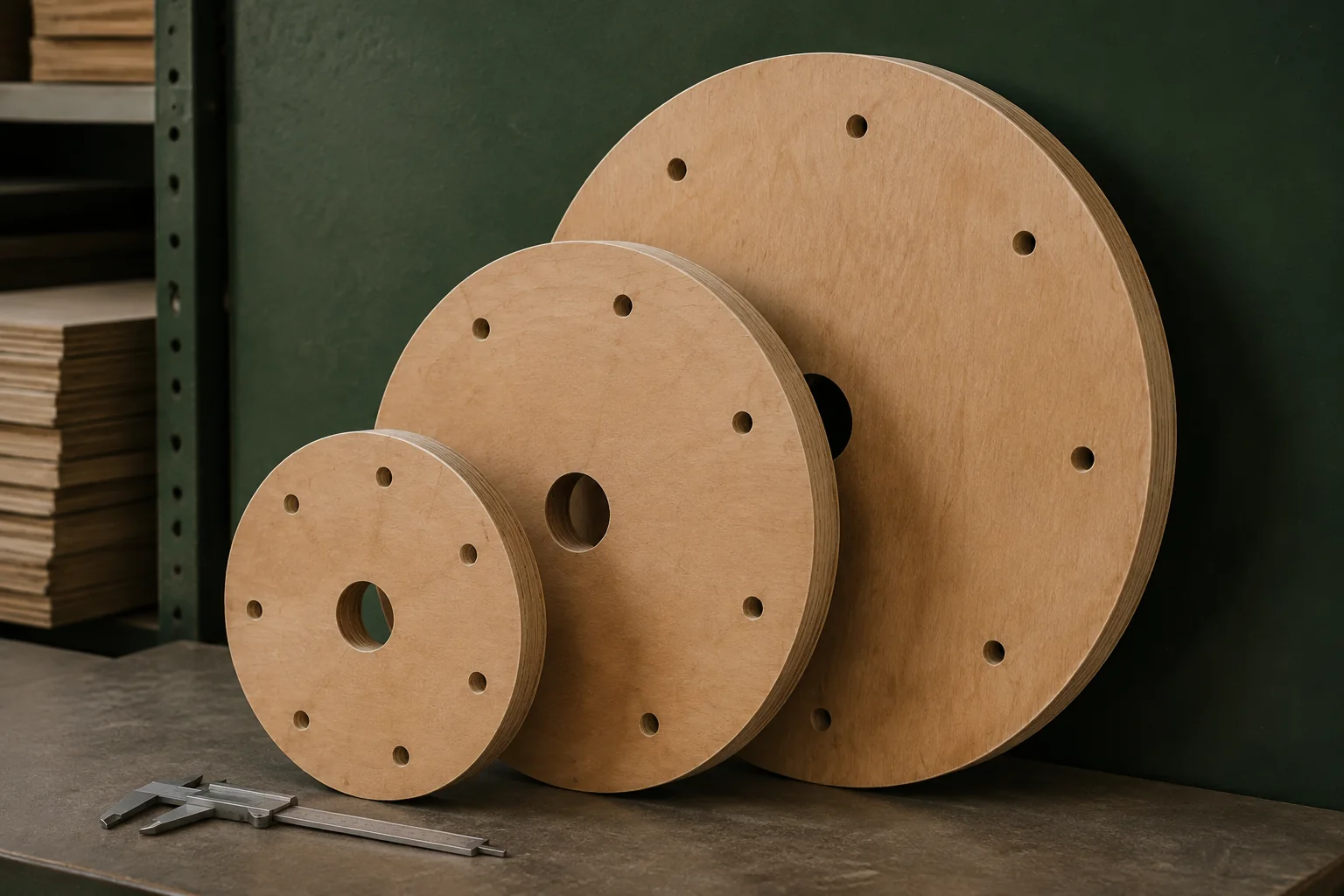
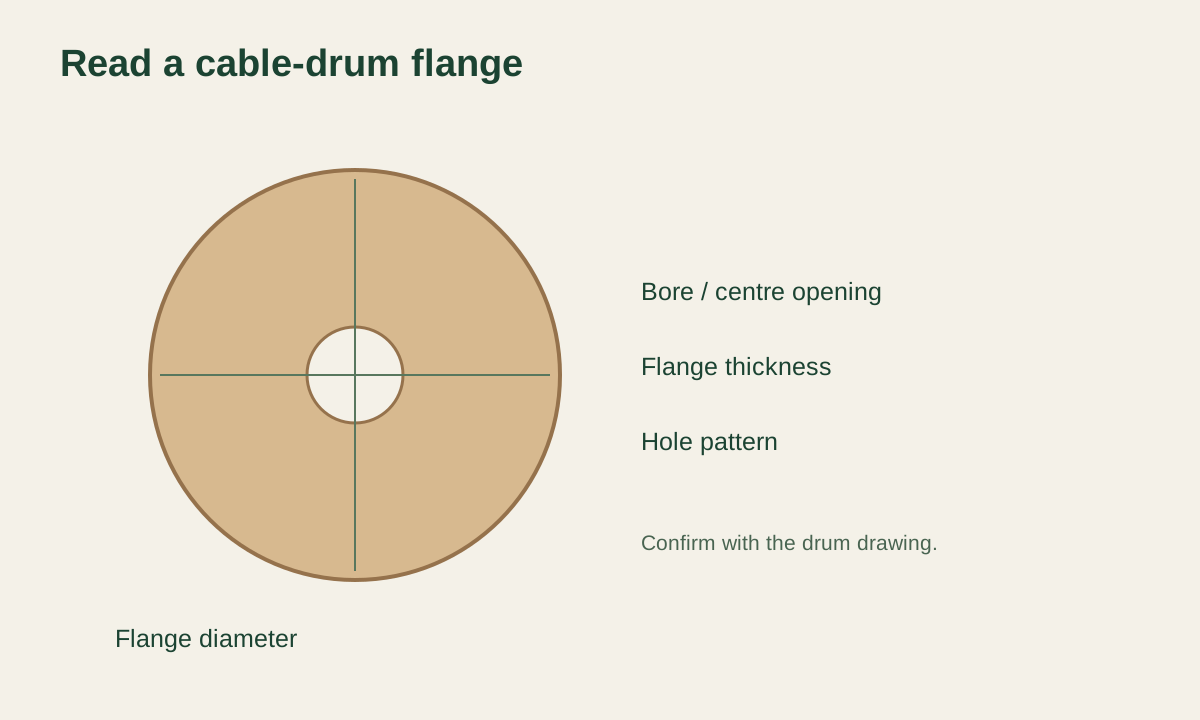
- Flanges — the two circular plywood discs that contain the wound cable. IS 10418 prescribes minimum thickness by drum size, grade, and load class.
- Barrel — the central wooden cylinder the cable is wound onto. Its outer diameter sets the minimum bend radius for the cable.
- Staves (lagging) — the outer wooden battens nailed across both flanges to protect the wound cable face. These are sawn timber, not plywood.
- Fasteners — through-bolts, threaded rods, washers and nuts that hold flange-to-barrel and flange-to-flange. The standard prescribes minimum bolt grade, count and edge distance.
IS 10418 also classifies drums by load class — light, medium and heavy — which in practice is what drives the ply thickness call. A 1400mm drum carrying 800 kg of LT cable is a very different mechanical problem from a 2000mm drum carrying 3,500 kg of armoured EHV cable, even though the flange diameter only differs by 600mm.
Drum-Code Reference Table
IS 10418 drum codes are named by flange outer diameter in centimetres. The barrel diameter and typical cable capacity follow the code. Use this as a starting reference when matching cable length and gauge to drum size — final selection depends on cable OD and winding pattern.
| IS Drum Code | Flange OD (mm) | Barrel OD (mm) | Typical Cable Capacity |
|---|---|---|---|
| DR-60 | 600 | 280 | Light control cable, 200-400 m |
| DR-80 | 800 | 355 | LT power cable up to 70 sq.mm, ~500 m |
| DR-100 | 1000 | 450 | LT armoured up to 185 sq.mm, ~500 m |
| DR-120 | 1200 | 560 | LT/MV armoured up to 240 sq.mm, ~500 m |
| DR-140 | 1400 | 710 | LT armoured 300-400 sq.mm, ~500-1000 m |
| DR-160 | 1600 | 800 | HT/MV cable up to 11 kV, ~500 m |
| DR-180 | 1800 | 900 | HT/EHV cable up to 33 kV, ~500 m |
| DR-200 | 2000 | 1000 | EHV cable up to 66 kV, ~300-500 m |
| DR-220 | 2200 | 1120 | EHV cable 132 kV and above, ~250-400 m |
Flange Diameter × Ply Thickness × Load Chart
This is where most drum-spec disputes actually live. A buyer asks for a 1600mm flange in 18mm ply because the last vendor quoted that way; the drum reaches site bowed and the cable face is contaminated. The chart below reflects practical load limits under IS 10418 for hardwood plywood flanges — gross load is total cable weight plus drum tare.
| Flange OD (mm) | 18mm Ply (max gross load, kg) | 22mm Ply (max gross load, kg) | 25mm Ply (max gross load, kg) | 28mm Ply (max gross load, kg) |
|---|---|---|---|---|
| 600 | 400 | 600 | 800 | 1000 |
| 800 | 500 | 750 | 1000 | 1300 |
| 1000 | 700 | 1000 | 1400 | 1800 |
| 1200 | 900 | 1300 | 1800 | 2300 |
| 1400 | 1100 | 1600 | 2200 | 2900 |
| 1600 | — | 1900 | 2700 | 3500 |
| 1800 | — | 2200 | 3200 | 4200 |
| 2000 | — | — | 3700 | 4900 |
| 2200 | — | — | 4200 | 5600 |
Dashes indicate combinations IS 10418 does not endorse — 18mm ply on anything over 1400mm is asking for in-transit flex. For drums above 1800mm carrying heavy EHV cable, 25mm or 28mm is the only safe call, and the standard expects the flange to be a single-piece disc, not jointed.
BWR vs BWP Grade Selection for Drums
The grade decision sits between the buyer's storage assumption and the drum's actual route. Cable drums often spend weeks in open godowns, sometimes outdoors on construction sites, sometimes at coastal ports.
- BWR (Boiling Water Resistant) — the workhorse for domestic cable dispatch. Phenol-bonded, IS 303 compliant, handles up to 60-90 days of covered outdoor storage in tropical inland conditions. Suitable for LT and MV cable drums on PAN-India routes.
- BWP (Boiling Water Proof) — a step up in resin loading and core quality. Use when the drum will sit at a coastal port, transit through monsoon, or be stored outdoors uncovered for 90+ days. Mandatory call for EHV cable exports leaving via Nhava Sheva, Mundra or Cochin.
A practical rule we apply at the Cochin Wood group, where the group has been milling and converting hardwood plywood since 1986: if the cable is over 33 kV or the buyer is an exporter, default to BWP. The cost delta is small compared to the cable value at risk.
Fastener Spec — Staves, Bolts & Threaded Rods
IS 10418's fastener clauses are short but unforgiving. Three numbers tend to be missed in the rush of PO drafting:
- Bolt grade — minimum class 4.6 mild steel for through-bolts, hot-dip galvanised for any drum likely to see humidity above 70%. Stainless is overkill for cable drums; galvanised is the right cost-benefit point.
- Bolt count by flange diameter — 4 through-bolts up to DR-100, 6 for DR-120 and DR-140, 8 for DR-160 and above. Threaded rods replace through-bolts on drums above DR-180 where the lever arm makes single bolts insufficient.
- Edge distance — bolt hole centre minimum 2× bolt diameter from the flange edge, and minimum 1.5× from the barrel-flange joint. Drilling closer creates the split that the flange fails along under transit shock.
Staves are softwood or rubberwood sawn timber, 18-25mm thick depending on drum diameter, nailed not screwed, spaced to allow a 25-40mm gap for ventilation. The staves are sacrificial — they take the abrasion in handling so the cable face does not.
ISPM-15 Considerations for Exported Drums
The moment a drum crosses an Indian port for export, ISPM-15 applies. The drum has two wood components in scope: the plywood flanges (technically processed wood, but several inspectors still flag) and the sawn timber staves and barrel.
- Plywood flanges — processed under heat and pressure during manufacture, so they are ISPM-15 compliant by process. Most inspectors accept the manufacturer's IPPC declaration. For zero ambiguity, ask your drum supplier to mark each flange with the IPPC stamp anyway.
- Sawn timber staves and barrel — must be heat-treated (HT) at the timber yard and stamped with the IPPC code, country code (IN), HT marker, and the treatment provider's BIS-registered number. The stamp goes on at least two staves per drum and on the barrel end.
- Fumigation alternative — methyl bromide (MB) treatment is still recognised under ISPM-15 but is being phased out by most destination countries. Default to HT unless the buyer has explicitly asked for MB.
A non-compliant stamp at destination port means the consignment is fumigated at owner's cost or returned. For a single EHV drum carrying eight figures of cable, that is not a risk worth taking to save the cost of treating and stamping the timber.
Sourcing Rules — What to Specify on a PO
An IS 10418 conforming drum order needs eight specifications on the PO. Anything missing gets defaulted by the supplier, which is where disputes start.
- IS 10418 drum code — DR-60 through DR-220, written exactly as the standard names them.
- Flange OD in mm, with tolerance (typically ±5mm).
- Barrel OD in mm — non-negotiable, sets the cable bend radius.
- Gross load — total cable weight plus drum tare, in kg. Drives the ply thickness call.
- Ply thickness and grade — e.g. "22mm BWR hardwood plywood, IS 303 conforming" or "25mm BWP".
- Fastener spec — bolt grade, count, threaded-rod call where applicable, galvanised or plain.
- ISPM-15 requirement — yes/no, with HT or MB call, and destination country if known.
- Marking — buyer code, drum serial, cable type, length, gross/net weight, and the standard arrows for handling. Painted or hot-stamped on at least one flange face.
Quoting Your Drum Requirement
Send your cable spec — type, voltage class, conductor size, length per drum — along with the IS 10418 drum code and required quantity. We quote with the matching flange OD, barrel OD, ply thickness and grade, fastener pattern and ISPM-15 status, and issue an IS 10418 conformance certificate with every dispatched drum from the Cochin Wood group's drum line. Our group has been in hardwood plywood manufacturing in Perumbavoor for forty years, and the drum specification is something we sweat the details on. Get a quote at the contact page.