
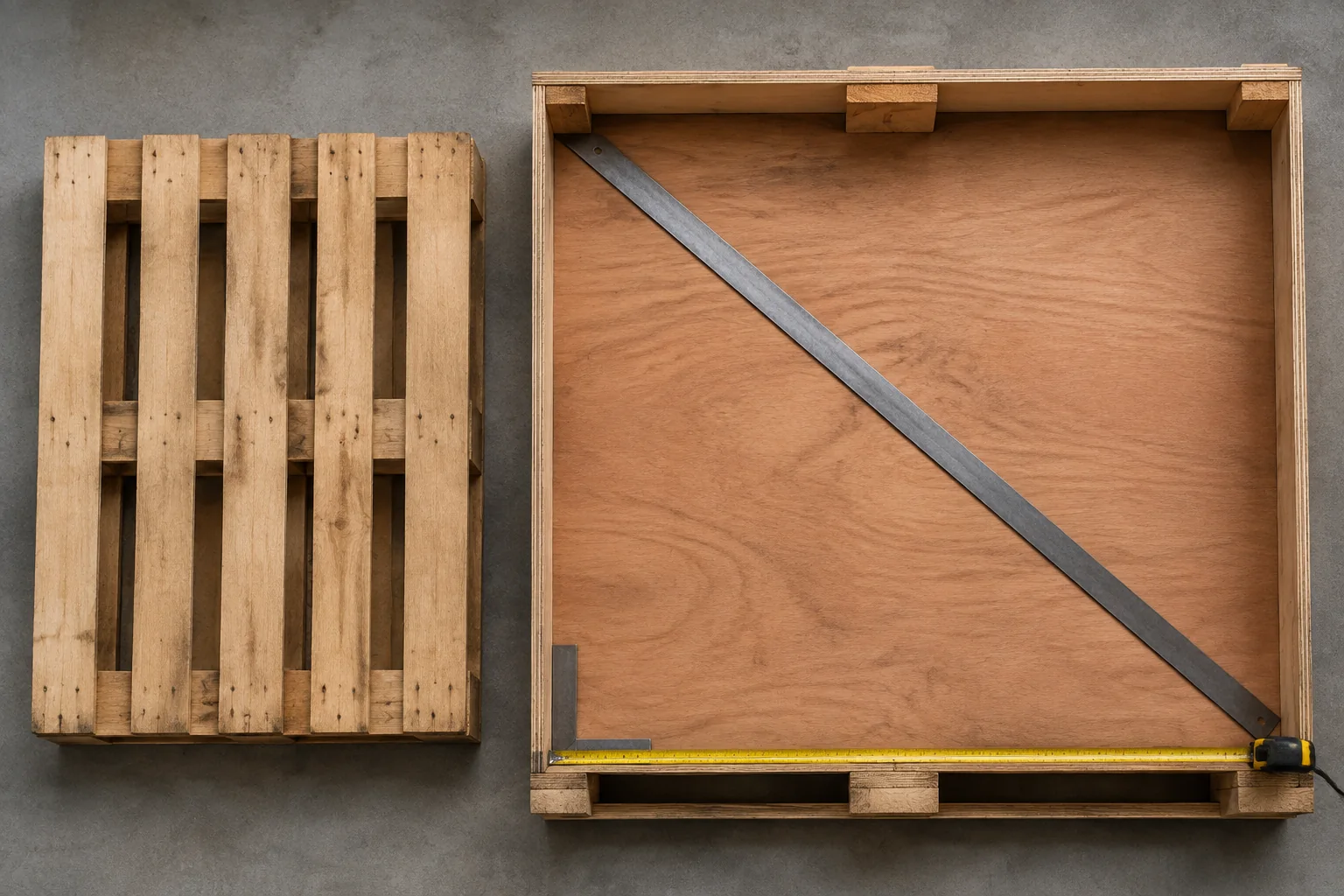
Most export crate problems are ordered, not built. The cargo data was incomplete, the treatment was assumed instead of specified, or the quote never stated what grade of plywood was actually going on the walls. This checklist is what our export desk wishes every first-time crate and pallet buyer sent — it is the difference between a quote you can hold a supplier to and a quote you discover the gaps in at the port.
Before you ask for prices: fix the cargo data
A crate or pallet quote is only as good as the load brief behind it. Settle these five numbers first, in writing:
- Gross weight per unit — the single biggest driver of construction. A 400 kg pump and a 4,000 kg gearbox are different products wearing the same word "crate".
- Dimensions and centre of gravity — tall or asymmetric loads change bracing and lifting-point design.
- Journey profile — containerised or break-bulk, transhipment count, and whether crates will be stacked.
- Handling at destination — forklift only, or crane slings? Four-way or two-way pallet entry?
- Storage exposure — weeks in a covered warehouse and weeks on an open quay call for different boards and different hardware.
The six things a crate quote must state
If any of these is missing from a supplier's written quote, ask for it before comparing prices. Suppliers who leave them vague are pricing the cheapest possible interpretation.
| Line | What it should say | Why it matters |
|---|---|---|
| Plywood grade | The bonding grade by name — MR, BWR or BWP — and the face (e.g. Okoume) | "Commercial ply" can mean four different boards; see which plywood suits packing cases |
| Thickness per panel | Walls, lid, base stated separately in mm | Bases carry the load; a quote that states one thickness is hiding something |
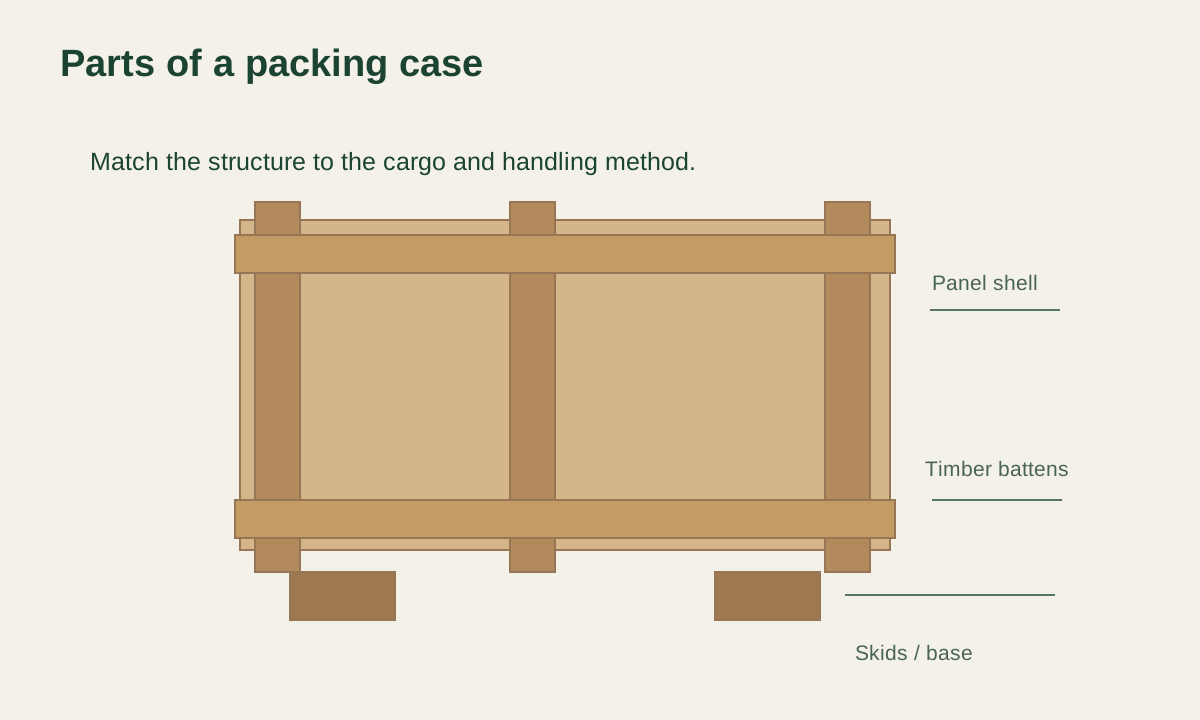
| Timber members | Species and section size of runners, skids and frames | Runner failure, not panel failure, is the most common pallet write-off |
| ISPM-15 treatment | Heat treatment with IPPC stamp, stated explicitly | Solid-wood members must be treated; plywood itself is exempt — here's why |
| Hardware and closure | Nail/screw/bolt pattern, strapping, lid fixing | Fastening is where cheap crates actually save their money |
| Marking | Shipping marks, handling symbols, IPPC stamp placement | Unmarked crates create quay-side disputes you pay for in time |
Qualifying the supplier, not just the quote
Three questions separate a packing-case manufacturer from a reseller with a saw:
- Where does the heat treatment happen? A real answer names the chamber and the registration behind the IPPC stamp. A vague answer means your stamp's traceability is somebody else's problem.
- Can you send the spec sheet before the order? A written specification — grades, sections, fastener schedule — that survives from quote to delivery is your only protection against quiet substitution.
- What happens on a failure claim? You learn more from how a supplier answers this than from any brochure.
Think in landed cost, not unit price
The cheapest crate on the quote sheet is rarely the cheapest crate at destination. One damaged consignment, one quarantine hold over a doubtful stamp, or one re-export of non-compliant packaging erases years of unit-price savings. For how the build cost actually stacks up, see what an ISPM-15 export crate costs.
FAQ
Should I buy crates locally at destination or ship goods pre-crated?
Pre-crating at origin almost always wins for engineered goods: the crate is built to the cargo, not the cargo squeezed into a stock crate, and the packing line takes responsibility for the fit. Local crating makes sense only when cargo is uncrated for installation anyway and local rules demand it.
What is the minimum order for export crates and pallets?
Ours is one truckload for domestic supply and one container's worth for export, mixed sizes allowed. Smaller trial orders are worth asking about when a larger programme sits behind them.
Do I need marine plywood for export crates?
Usually not. BWR-grade packing plywood handles sea-freight humidity for typical voyages. Marine-grade BWP earns its premium on deck cargo, repeated-use crates and high-value loads — the material question is covered in plywood for packing cases.
Who is responsible if my packaging is rejected at the destination port?
Contractually, usually you — which is exactly why the treatment line in the quote, the stamp on the wood, and the certificate in the document pack must all come from the same traceable source.
What the Cochin Wood group recommends
Send the five cargo numbers above with your enquiry and ask for all six quote lines in writing. That is how our own packing desk quotes: grade named, sections stated, treatment certified, marks agreed — before the first board is cut.
Send your cargo brief and we'll return a written crate or pallet specification with the quote. Product detail: Plywood Boxes & Crates · Plywood & Wooden Pallets.